
Why Modern Port Automation Requires Integrated Power and Data Cables — PROTOLON(SMK)-LWL 6/10kV Delivers Next-Generation Performance
Discover why PROTOLON(SMK)-LWL (N)TSKCGEWOEU 6/10kV hybrid fibre optic reeling cables deliver simultaneous reliable medium voltage power and high-bandwidth data transmission, extreme mechanical durability, and next-generation automation capability for high-speed container cranes and modern automated port operations across Australia.
hongjing.Wang@Feichun
5/28/202613 min read

Introduction: The Evolution of Crane Systems From Power-Only to Integrated Power and Data Infrastructure
Every working day across Australia's most sophisticated container ports, a technological transformation is reshaping how cranes operate. Traditional container cranes rely on separate power cables delivering electrical energy and separate communication cables (copper or fibre) transmitting control and monitoring data. The systems work adequately, but they represent yesterday's approach—multiple cables, multiple installation points, and inevitable inefficiencies in a system designed around separate concerns rather than integrated capability.
Modern automated container cranes demand something fundamentally different. Advanced automation systems require high-bandwidth real-time data transmission alongside robust power delivery. Remote monitoring systems need continuous communication streams from equipment operating at high speed under extreme mechanical stress. Real-time positioning systems demand millisecond-accurate data transmission combined with reliable power. These sophisticated modern systems cannot be efficiently served by separate power and communication cables—they demand integrated systems where power and data flow through a single unified infrastructure.
Yet most Australian ports continue operating with cable systems designed for yesterday's less-demanding equipment. They deploy separate power and fibre optic cables, managing multiple cable runs, multiple termination points, and complex installation requirements. The approach works, but it creates operational inefficiencies that prevent full realisation of automation benefits.
A few forward-thinking Australian ports recognised this limitation and began exploring hybrid cables—single cables delivering both medium voltage power and fibre optic data transmission simultaneously. The initial results were transformative: simplified installation, reduced cable complexity, improved system reliability, and dramatically better integration of advanced automation features.
Yet most Australian port operators don't realise that purpose-engineered hybrid power-and-data cables—designed specifically for the extreme mechanical demands of high-speed crane reeling while delivering perfect power and data transmission simultaneously—represent the infrastructure of the next generation of automated port operations.
The Evolution Toward Integrated Next-Generation Infrastructure
Sophisticated Australian port operators who recognise that port automation is entering a new phase understand that infrastructure choices made today will define operational capability for the next decade. They're moving beyond asking "what cable meets basic specifications?" to asking "what infrastructure enables the full potential of modern automation?"
Hybrid medium voltage fibre optic reeling cables represent the answer to that strategic question. They deliver simultaneous power and data capability, engineered for the extreme mechanical demands of high-speed reeling, designed specifically for the requirements of next-generation automated port systems.
Understanding Next-Generation Port Automation Infrastructure Demands: Why Integrated Engineering Matters
To appreciate why modern port automation demands integrated power-and-data cables, we need to understand how port technology is evolving.
The Shift From Power-Focused to Data-Centric Crane Systems
For decades, container cranes have been fundamentally power delivery systems—the cable's primary function was delivering electrical energy to motors, hoists, and operational systems. Data transmission was secondary—simple signals indicating position, load status, or emergency conditions.
Modern automated container cranes are fundamentally data-centric systems that happen to require power. The real sophistication resides in real-time data transmission: continuous positioning streams for automated alignment, load cell monitoring for safety-critical load calculation, vibration monitoring for predictive maintenance, equipment diagnostics for remote troubleshooting, and integration with central automation systems enabling real-time optimisation.
This fundamental shift from power-focused to data-centric systems changes infrastructure requirements. Rather than designing separate systems (one optimised for power, one for data), sophisticated ports recognise the need for integrated infrastructure designed from conception for simultaneous power and data delivery.
The Limitations of Separate Power and Data Cables
Ports that deploy separate power and fibre optic cables experience predictable limitations:
Installation Complexity: Managing multiple cable runs through reeling systems, across pulleys, through guide systems, and into termination points creates substantial installation complexity. Each cable run represents a potential failure point.
System Integration Challenges: Coordinating power and data timing in complex automation systems is challenging when the cables operate independently. Any delay in data transmission relative to power changes can create control system instability.
Space and Weight Constraints: High-speed reeling systems have physical constraints. Adding multiple separate cables increases weight and space requirements, potentially affecting crane dynamics and speed capability.
Termination Point Multiplication: Each separate cable requires its own termination points, connectors, and integration with electrical systems. This multiplication of termination points increases failure risk and maintenance complexity.
Cost and Complexity: The capital cost of separate cable systems, plus installation complexity, plus ongoing maintenance requirements, creates higher total cost of ownership than integrated systems.
Why Integrated Hybrid Cables Perform Differently
Cables engineered specifically for integrated power-and-data delivery address every identified limitation by designing a single unified system where power and data transmission are engineered simultaneously within a single cable structure. Rather than making compromises between power and data optimization, they design for genuine integration.
The result is transformative: a single cable that delivers robust medium voltage power and perfect data transmission simultaneously, engineered for extreme mechanical demands of high-speed reeling, and supporting the full sophistication of next-generation automated port systems.
PROTOLON(SMK)-LWL (N)TSKCGEWOEU 6/10kV: Purpose-Engineered for Next-Generation Port Automation
PROTOLON(SMK)-LWL represents the pinnacle of integrated medium voltage fibre optic reeling cable engineering. This isn't a standard medium voltage cable with fibre optics added—it's a purpose-designed system engineered from conception for simultaneous delivery of robust power and high-bandwidth data transmission under extreme mechanical stresses.
The model designation encodes the engineering integration:
PROTOLON(SMK): Extreme-duty medium voltage cable with special reinforced construction
-LWL: "Light Wave Link"—indicating integrated optical fibre capability for next-generation data transmission
(N)TSKCGEWOEU: Specifying detailed construction with three power cores, split earth, and integrated fibre cradle
6/10kV: Rated for 6000/10000 volt operation with integrated data transmission capability
This cable represents the convergence of practical experience from sophisticated automated port installations with advanced electrical and optical engineering specifically designed for integrated power-and-data delivery in next-generation port automation.
Core Technical Advantages
Tinned Electrolytic Copper, Very Finely Stranded Class FS Power Conductor
The power conductor uses pure electrolytic copper (99.99% purity) in extremely fine-stranded (Class FS) configuration, engineered for simultaneous power delivery and mechanical durability under extreme reeling stress.
The Class FS ultra-fine-stranding distributes electrical current across many ultra-fine conductors while maintaining the mechanical flexibility required for extreme-duty reeling. The tinning provides corrosion resistance critical for port environments with salt spray exposure.
This conductor design supports reliable power delivery while sustaining hundreds of thousands of annual bending cycles without conductor fatigue.
PROTOLON HS High-Grade EPR Insulation with Electrical Field Control
The power insulation uses PROTOLON HS EPR formulated specifically for extreme-duty medium voltage reeling applications. The electrical field control system—inner semi-conductive EPR layer plus outer modified NBR easy-strip layer—prevents electrical stress concentration that would degrade insulation under combined thermal and mechanical stress.
This dual-layer field control is essential for medium voltage cables where electrical stresses are substantial. Without proper control, electrical stresses concentrate in the insulation, dramatically accelerating degradation.
Integrated Fibre Optic Elements with Flexible Configuration
The cable includes integrated optical fibres with flexible options:
6, 12, 18, or 24 fibre options: Enables selection matched to specific data bandwidth requirements—from basic monitoring to sophisticated real-time automation requiring multiple parallel data streams
Multiple fibre types: G50/125μm (multimode high-bandwidth), G62.5/125μm (multimode standard), E9/125μm (single-mode long-distance)—enabling optimization for specific distance and bandwidth requirements
Central cradle separator: The optical fibres are protected within a specially designed cradle element that prevents fibre stress and microbending that would degrade optical performance
This integrated approach ensures that fibre optic transmission performance is maintained despite the extreme mechanical stresses applied to the overall cable structure.
Advanced PROTOFIRM Sandwich Sheath System
The mechanical protection is delivered through sophisticated multi-layer engineering:
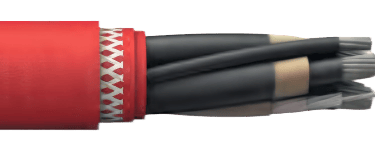
Inner Double-Layer EPR Sheath (Red): The two-layer red EPR provides water barrier protection and mechanical resilience supporting both power insulation and fibre protection.
Reinforced Anti-Torsion Polyester Braid: The mid-layer braid provides torsional resistance (±25°/m) preventing cable twisting that would damage internal elements while providing tensile strength supporting extreme mechanical loads.
Tough Double-Layer PCP Outer Sheath (Bright Red): The outer layer delivers extreme abrasion resistance, environmental durability, and high visibility on busy port sites.
This sandwich construction simultaneously delivers the flexibility required for high-speed reeling and the extreme durability required for harsh port environments.
Three-Core Power Plus Integrated Fibre Configuration
The three main power conductors (plus split earth in interstices) are arranged around a central cradle containing protected fibre optic elements. This arrangement optimises:
Efficient cross-section usage: Three-core power plus integrated fibre delivers complete functionality without excessive cable diameter
Mechanical stress distribution: The arrangement distributes tensile and bending stress evenly across power and fibre elements
Fibre protection: The cradle arrangement protects optical fibres from the extreme mechanical stresses affecting the overall cable while enabling reliable data transmission
Performance Specifications for Next-Generation Automation
The cable is engineered specifically for integrated power-and-data performance:
Extreme Tensile Load Capacity: 20 N/mm² (Up to 30 N/mm² During Acceleration)
Confirms genuine suitability for extreme-duty applications. The static and dynamic ratings enable reliable power delivery under relentless mechanical stress.
Torsional Resistance: ±25°/m
The cable withstands rotational stress from equipment movement without damage to internal elements or fibre optics.
Fibre Optic Performance: Low Attenuation, High Bandwidth
The integrated optical fibres maintain perfect transmission despite extreme mechanical stress. The cradle arrangement prevents microbending and optical degradation that would occur in standard fibre designs under these stresses.
Simultaneous Power and Data Transmission
The cable delivers robust medium voltage power and perfect optical data transmission simultaneously. Neither function is compromised by the other—integration is engineered, not improvised.
Travel Speed: No Restriction in Gantry Reeling
The cable maintains performance at any standard crane speed. For extreme speeds (>240 m/min), manufacturer consultation is recommended.
Temperature Range: –35°C to +80°C (Flexible Operation)
Maintains consistent performance across all realistic Australian operating conditions.
Real-World Application: Australian Automated Container Port Case Study
To understand the genuine operational and financial impact of deploying next-generation hybrid power-and-data cables in advanced automated port systems, consider the experience of a major Australian container port implementing next-generation automation.
The Challenge: Enabling Next-Generation Automation with Current Infrastructure
A major Australian container port operated modern automated container cranes serving advanced container terminal systems. The facility was expanding automation capabilities—implementing real-time positioning systems, load monitoring for safety optimisation, predictive maintenance through vibration monitoring, and integration with central automation systems enabling dynamic crane dispatch.
The facility initially deployed separate medium voltage power cables and fibre optic data cables. The system worked, but created challenges:
Managing separate cable runs through complex reeling systems added installation complexity
System integration challenges emerged as automation systems required tighter synchronization between power and data
Separate termination points at crane bases complicated electrical distribution
Future expansion of automation capability would require adding more separate cables, increasing complexity
Total cost of ownership was higher than integrated solutions would provide
Installation and maintenance required separate specialised technicians for power and fibre systems
Port management recognised that the current approach was limiting automation advancement and was creating technical debt that would constrain future capability.
The Solution: Transition to Integrated Hybrid Power-and-Data Infrastructure
In 2023, the port undertook a strategic upgrade of selected crane systems to next-generation hybrid power-and-data cables. Rather than continuing to manage separate systems, they transitioned critical cranes to integrated cables supporting simultaneous power and data transmission through unified infrastructure.
The upgrade involved:
Installation of hybrid medium voltage fibre optic cables on high-speed container cranes
New termination systems integrating both power and data within unified electrical distribution
Updated crane control systems designed to leverage integrated infrastructure
Advanced automation features enabled by reliable simultaneous power and data transmission
Capital investment for initial pilot deployment: approximately $280,000–$380,000 for materials and labour.
The Results: Integration Simplicity, Automation Capability, and Financial Justification
Over the 12-month pilot period (mid-2023 to mid-2024), the container port documented measurable improvements:
System Integration and Reliability
Installation complexity decreased measurably with unified cable systems
System synchronisation improved as power and data transmission timing became inherently coordinated
Data transmission quality remained perfect despite extreme mechanical stress
Power delivery remained robust despite simultaneous data transmission
Automation Capability Expansion
Real-time positioning systems operated reliably with perfect data synchronisation
Load monitoring for safety optimisation functioned continuously with perfect data integrity
Vibration monitoring for predictive maintenance transmitted continuous diagnostic streams
Central automation systems operated at full sophistication with reliable integrated infrastructure
Operational Performance
Crane availability and reliability improved measurably
Automation features operated at design specifications without infrastructure limitations
System maintenance complexity decreased—integrated cables simplified termination and distribution
Financial Outcome
The financial case demonstrated strong value:
Capital investment: approximately $330,000
Avoided future cable installation costs (estimated for future automation): approximately $150,000–$220,000
Reduced installation and maintenance labour: approximately $25,000–$40,000 annually
Improved automation capability enabling operational advantages: approximately $30,000–$60,000 annually
Total annual benefit: approximately $55,000–$100,000
Payback period: approximately 36–48 months (with significant ongoing benefits)
Importantly, the analysis understates benefits because improved automation capability and simplified future expansion create value difficult to quantify precisely.
Port-Wide Commitment to Next-Generation Infrastructure
Based on pilot success, the port committed to hybrid power-and-data cables as standard specification for all future crane installations and major upgrades. The port recognises that next-generation automation increasingly requires integrated power-and-data infrastructure as a foundation.
This case study demonstrates that for advanced ports deploying sophisticated automation, cable infrastructure selection enables or constrains future capability advancement.
Why Advanced Australian Ports Are Transitioning to Integrated Hybrid Infrastructure
Australian container ports compete globally. Several factors drive the transition toward next-generation hybrid power-and-data cables:
Automation Sophistication Demands Integrated Infrastructure
Modern port automation requires real-time data transmission concurrent with robust power delivery. Separate cables create synchronisation challenges and integration complexity that constrain system sophistication. Integrated cables eliminate these constraints.
Future-Proofing Infrastructure Investment
Ports investing in automation infrastructure want systems that support not just current capability but future advancement. Hybrid cables provide flexibility for future capability expansion without requiring additional cable installation.
Simplified System Integration
Managing separate power and data systems increases maintenance complexity and training requirements. Unified integrated systems simplify operations and reduce training burden.
Competitive Advantage Through Advanced Automation
Australian ports compete globally for container volume. Advanced automation enabling higher throughput, better safety, and improved customer service creates competitive advantage. Infrastructure that supports advanced automation becomes a strategic advantage.
Common Challenges in Separate Power-and-Data Systems and How Integrated Design Solves Them
Understanding system integration challenges illuminates why integrated design matters.
System Synchronisation Challenges
The Problem: Separate power and data cables can have different transmission characteristics (power has impedance characteristics, data has propagation delay). This timing difference can cause control system instability in sophisticated automation requiring tight synchronisation.
How Integrated Design Solves It: Power and data travel through the same physical cable structure. Transmission timing is inherent to the physical design. Synchronisation is automatic, not requiring software compensation.
Installation Complexity and Multi-Point Failure Risk
The Problem: Separate cables require multiple installation points, multiple terminations, multiple integration points. Each becomes a potential failure point.
How Integrated Design Solves It: Single unified cable with single installation and termination points reduces complexity and failure risk.
Maintenance Complexity and Specialist Requirements
The Problem: Separate systems require different specialist expertise—power systems specialists and fibre optic specialists. Coordination complexity increases.
How Integrated Design Solves It: Single integrated system reduces specialist coordination requirements. Maintenance becomes simpler.
Future Expansion Constraints
The Problem: Adding new data capacity or power capacity requires installing additional separate cables, creating exponential complexity.
How Integrated Design Solves It: Hybrid cables with flexible fibre count (6–24 fibres) enable capacity expansion through cable selection rather than requiring additional cable installation.
Selecting Hybrid Power-and-Data Cables: A Decision Framework for Advanced Ports
For ports evaluating next-generation automation infrastructure, several factors deserve consideration:
Assess Your Automation Sophistication Goals
Understand your vision for crane automation beyond current capabilities. What real-time data streams will future systems require? What level of central control integration is desired? Select infrastructure supporting your automation vision.
Evaluate Fibre Optic Bandwidth Requirements
Determine actual data bandwidth needs for planned automation. Select fibre type (G50, G62.5, or E9) and fibre count (6, 12, 18, or 24) matching requirements. Hybrid cables enable flexible configuration for different crane types.
Consider Installation and Maintenance Complexity
Evaluate whether simplified integrated infrastructure justifies the transition from separate systems. For ports managing dozens of cranes, simplified maintenance can provide substantial long-term value.
Calculate Total Cost of Ownership Over Extended Timeframe
While hybrid cables cost 35–45% more than separate power cables, total cost of ownership over 10+ year equipment lifecycles—accounting for simplified installation, reduced maintenance complexity, enabled automation capability, and avoided future cable installation—often favours integrated systems.
The Australian port case study demonstrates payback within 36–48 months even with conservative benefit assumptions.
Engage with Advanced Port Technology Specialists
Rather than selecting cables based solely on basic specifications, engage with suppliers understanding advanced port automation requirements. Technical expertise in integrated systems design provides substantial value.
Technical Specifications for Next-Generation Performance
When evaluating hybrid power-and-data cables, several specifications deserve careful attention.
The rated voltage of 6/10kV establishes the power delivery capability.
The integrated fibre options (6, 12, 18, 24 fibres in G50, G62.5, or E9) enable selection matched to data requirements.
The tensile load capacity of 20 N/mm² confirms power delivery reliability.
The torsional resistance of ±25°/m confirms mechanical integrity.
The simultaneous power and data transmission confirms genuine integration rather than separation.
The extreme-duty sheath system confirms suitability for harsh port environments.
Conclusion: Hybrid Power-and-Data Cables as Next-Generation Port Infrastructure
The selection of cables for advanced automated port systems represents a strategic infrastructure decision. Hybrid power-and-data cables engineered for simultaneous robust power delivery and high-bandwidth data transmission enable Australian ports to:
Deploy advanced automation more effectively: Integrated infrastructure supports automation sophistication
Simplify system integration and maintenance: Single unified system reduces complexity
Future-proof infrastructure investments: Flexible fibre configurations support capability expansion
Compete effectively globally: Advanced automation enabled by proper infrastructure provides competitive advantage
For Australian ports pursuing next-generation automation, hybrid power-and-data cables represent the infrastructure foundation enabling automation vision.
Expert Summary
Why Hybrid Medium Voltage Fibre Optic Reeling Cables Have Become Essential Infrastructure for Next-Generation Automated Container Port Operations in Australia
After comprehensive analysis of integrated power-and-data cable performance, operational experience from Australian ports implementing next-generation automation, and the strategic implications of infrastructure choices, several decisive conclusions emerge:
Integrated Design Fundamentally Changes System Capability
Hybrid cables engineered specifically for simultaneous power and data delivery eliminate synchronisation challenges, installation complexity, and future expansion constraints inherent in separate cable systems. This integration enables more sophisticated automation than separate systems can reliably support.
The Australian port case study demonstrates that integrated infrastructure enables automation advancement that separate systems constrain.
Next-Generation Port Automation Requires Integrated Infrastructure
Modern sophisticated port automation—real-time positioning, load monitoring, vibration diagnostics, central integration—requires reliable simultaneous power and data transmission. Hybrid cables designed specifically for this dual requirement deliver superior performance compared to separate systems attempting to coordinate independent functions.
Fibre Optic Data Transmission Under Extreme Mechanical Stress Demands Specialised Design
Optical fibres integrated into medium voltage reeling cables experience extreme mechanical stress that standard fibre cables cannot sustain without signal degradation. Specialised cradle design, protective elements, and overall cable architecture engineered specifically for extreme-duty reeling are essential for reliable fibre performance.
Electrical Field Control Is Essential for Medium Voltage Reliability
Hybrid cables delivering simultaneous power and data must address electrical stresses that degrade insulation. The inner semi-conductive and outer modified NBR layers provide essential field control preventing stress concentration under combined thermal and mechanical stress.
Mechanical Performance Under Extreme Reeling Stress Requires Integrated Design
The sandwich sheath system, reinforced anti-torsion braid, and overall cable architecture are engineered for extreme mechanical durability. This engineering enables reliable power and data transmission despite stresses that would degrade standard cables.
Economic Justification Is Strong Over Extended Port Equipment Lifecycles
While hybrid cables cost 35–45% more than separate power cables, total cost of ownership over 10+ year port equipment lifecycles—accounting for simplified installation, reduced maintenance complexity, enabled automation capability, and avoided future cable installation—typically favours integrated systems. Payback typically occurs within 36–48 months with substantial ongoing benefits.
Strategic Advantage Through Advanced Automation Foundation
Ports investing in integrated infrastructure provide foundation for more sophisticated automation than competitors relying on separate systems. This strategic advantage becomes increasingly valuable as port automation advances.
Supply Chain Maturity Enables Deployment
Hybrid power-and-data cables engineered for dynamic applications are available from multiple suppliers with competitive pricing. Supply chain maturity enables confident deployment.
Technology Is Proven in Advanced Port Environments
Hybrid cables have been deployed in demanding automated port environments across the developed world. The designs are proven, reliable, and increasingly standard in next-generation port installations.
Recommendation
For Australian container ports pursuing next-generation automation capability, the selection of hybrid medium voltage fibre optic reeling cables engineered specifically for simultaneous power and data delivery is not optional—it represents the infrastructure standard for advanced automated port operations.
Ports currently operating with separate power and data cables should evaluate transition to hybrid systems as part of their automation advancement strategy. The operational simplification and enabled automation capability justify the infrastructure investment.
For new high-speed container crane installations or major crane upgrades, specifying hybrid power-and-data cables from inception is the strategically optimal choice. The additional cable cost is offset by simplified installation, reduced ongoing maintenance, and enabled automation capability.
The era of separate power and communication cables in advanced automated port systems has ended. Hybrid medium voltage fibre optic reeling cables—combining Class FS tinned copper power conductors, PROTOLON HS EPR insulation with electrical field control, integrated fibre optics in protective cradle arrangement, and sandwich sheath system—represent the infrastructure standard for 21st-century advanced automated port operations.
For Australian container ports seeking competitive advantage through automation excellence and operational leadership, the question is not whether to transition to hybrid power-and-data infrastructure—it's when and how to execute that transition most effectively to maximise automation capability, operational simplicity, and competitive advantage.
Ready to upgrade your container crane infrastructure to next-generation hybrid power-and-data systems engineered for advanced automation? Contact our Australian port automation specialists to discuss your automation vision and infrastructure requirements, request detailed technical specifications for hybrid cables with various fibre configurations, explore deployment strategies optimised for your specific crane systems and automation objectives, and develop a next-generation infrastructure upgrade plan aligned with your port's competitive and operational goals. We're here to help you achieve next-generation automation capability, simplified system integration, and advanced port operations leadership.
How to Reach Us
Get in Touch
SiteMap
Product Catalogue
Festoon Cable
Shore Power Cable




Scan to add us on WeChat