YSLTÖ-J Spreader Cable for Vertical Basket Operation: Design, Performance, and Best Practices
YSLTÖ-J spreader cable engineered to DIN VDE 0250 with EPR insulation and polychloroprene sheath, designed for vertical basket operation in container cranes. High tensile strength, UV-resistant and abrasion-resistant spreader cable for harsh port environments.
hongjing.Wang@Feichun
2/24/20268 min read

Why Vertical Basket Spreader Cables Require Specialized Design
In the demanding world of container crane operations, the electrical cable connecting a spreader basket to the crane structure is far more than a simple conductor. A spreader cable for container cranes must endure a uniquely punishing combination of mechanical stresses that standard flexible cables simply cannot tolerate over a meaningful service life. Each hoisting cycle subjects the cable to simultaneous torsional forces, axial tensile loading, and multi-directional bending — all while the cable hangs vertically and must transmit both power and control signals without interruption.
The vertical basket cable arrangement is particularly critical because the cable effectively carries its own weight under repeated dynamic loading. Any elongation of the conductor bundle, any tendency to twist, or any degradation of the outer jacket can cascade rapidly into electrical failure or, in extreme cases, mechanical rupture. Standard reeling cables or festoon cables, designed for lateral travel or horizontal drag chain applications, lack the structural architecture required to manage continuous vertical suspension loads. This is precisely where the YSLTÖ-J spreader cable was engineered to excel — as a purpose-built solution for the most mechanically severe cable application found in modern port infrastructure.
What Is the YSLTÖ-J Spreader Cable?
The YSLTÖ-J is a special-purpose power cable designed and manufactured in conformance with DIN VDE 0250, the European standard governing flexible cables and cords for special applications. Its designation reflects the core construction principles: stranded conductors, EPR core insulation, and a polychloroprene outer sheath, adapted specifically for the torsion-controlled transmission of electrical power in vertical basket crane systems.
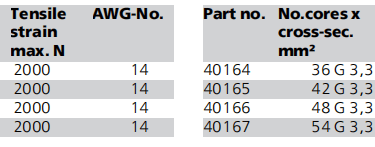
Unlike conventional flexible cables that prioritize lateral flexibility or track movement, the YSLTÖ-J spreader cable specification centers on tensile integrity and torsional equilibrium. The cable is offered in multi-core configurations ranging from 36 to 54 conductors with cross-sections of either 2.5 mm² or 3.3 mm², covering a broad range of current-carrying requirements for modern spreader systems. Available part numbers span configurations from 36G 2.5 to 54G 3.3 mm², providing engineering teams with precise options for both standard and high-capacity vertical basket cable applications. The nominal voltage rating of 300/500 V makes the cable compatible with the low-voltage power distribution systems standard in crane control architecture.

Structural Design Optimised for Vertical Basket Operation
The performance of the YSLTÖ-J under extreme mechanical stress is a direct result of its layered structural architecture, each element carefully selected to contribute a specific functional property.
Fine-Stranded Copper Conductors
At the core of each individual conductor lies fine-wire or extra-fine-wire bare copper, stranded to Class 5 or Class 6 in accordance with IEC 60228 / DIN VDE 0295. This high strand count ensures that the conductor bundle can flex repeatedly without individual wire fracture — a critical requirement when the cable undergoes thousands of bending and straightening cycles over its operational lifetime. The inherent ductility and low resistivity of copper also ensure that current-carrying capacity is maximised for a given cross-sectional area.
EPR Core Insulation for Thermal and Mechanical Stability
Each conductor is insulated with a specially formulated Ethylene Propylene Rubber (EPR) compound. EPR insulation provides outstanding resistance to moisture penetration, thermal ageing, and ozone attack — all of which are significant concerns in the salt-laden, humid atmosphere typical of coastal and marine container terminals. The EPR insulated spreader cable achieves a maximum continuous operating temperature of +90 °C at the conductor, with a permissible short-circuit temperature of +150 °C, ensuring that the cable can handle transient overloads without insulation breakdown. Core identification follows DIN VDE 0293, with black cores numbered continuously in white for unambiguous termination.
Kevlar Central Strength Member
The most distinguishing structural feature of the YSLTÖ-J is the Kevlar reinforced crane cable architecture. A central Kevlar element — an aramid fibre strength member — runs axially through the stranded core assembly. The cores are wound around this Kevlar element at an optimised lay length designed to balance torsional forces during vertical deployment. The Kevlar strength member is capable of absorbing a maximum tensile load of 2,000 N, effectively decoupling the mechanical suspension load from the electrical conductors themselves. This prevents elongation of the cable under its own weight and the dynamic loads of basket operation, protecting conductors from fatigue fracture and insulation from tensile stress.
Polychloroprene Outer Sheath
The polychloroprene crane cable sheath — black (RAL 9005) — provides the final barrier against the harsh port environment. Polychloroprene (CR) is well established as one of the most durable elastomeric sheathing materials for industrial cable applications, offering excellent resistance to abrasion, oil, and ozone. As an outdoor spreader cable, the YSLTÖ-J must also contend with prolonged ultraviolet radiation exposure, for which polychloroprene is inherently well suited. The sheath also contributes to the overall flexibility of the assembly, allowing the cable to conform to the natural curvature of the basket suspension path without cracking or surface crazing.
Mechanical Performance in Vertical Basket Systems
Torsion control is the single most critical mechanical property for a torsion resistant spreader cable operating in a vertical basket crane. When a cable is suspended vertically and subjected to rotational forces — arising from wind loading, basket yaw, or uneven lay-length behaviour — an uncontrolled torsion response will cause the cable to twist progressively with each hoisting cycle until the conductors are mechanically compromised.
The YSLTÖ-J addresses this through its optimised lay length and the balanced winding of cores around the central Kevlar element. The stranding geometry is specifically calculated to achieve near-zero net torque under axial load, minimising the tendency of the cable to rotate under the weight of the hanging basket. The minimum bending radius is specified at 15 times the cable outer diameter — a figure that must be strictly observed at all termination points and cable entry saddles to prevent conductor fatigue at the anchor zones.
Environmental Durability in Port and Outdoor Conditions
The UV resistant crane cable designation of the YSLTÖ-J is not incidental — it is a functional necessity for container crane applications where cables may be exposed to intense solar radiation for the entirety of their service life. Port environments combine UV exposure with salt spray, temperature cycling, and occasional hydraulic fluid or lubricant contamination, all of which challenge the sheath material integrity.
The standard operating temperature range of -20 °C to +60 °C covers the climatic envelope of virtually all major container port locations worldwide. For installations in arctic or sub-arctic environments, the -K model variant extends the operating range to -40 °C to +80 °C, maintaining sheath flexibility at temperatures where standard polychloroprene compounds would become brittle. The cable is rated for deployment in dry, moist, wet, and open-air environments — exactly the exposure categories encountered in ship-to-shore and rail-mounted gantry crane service.
Electrical Ratings and Safety Compliance
From an electrical engineering perspective, the 300/500 V spreader cable rating defines the permissible phase-to-earth and phase-to-phase voltage levels respectively, in accordance with IEC 60227 / IEC 60245 convention. The current carrying capacity of individual conductors is determined per DIN VDE 0298 part 4, which prescribes the permissible current for flexible cables in various installation configurations. Designers must select the appropriate conductor cross-section — 2.5 mm² or 3.3 mm² — based on the actual load profile of the spreader's actuator motors, solenoid valves, and control circuits, with appropriate derating applied for the multi-core bundled configuration.
A dedicated green-yellow (GN-YE) protective earth conductor is integral to the cable construction, ensuring reliable protective bonding between the crane structure and the spreader frame in compliance with IEC 60364 requirements for electrical safety in crane installations. The product conforms to the EC Low-Voltage Directive 2006/95/EC, as indicated by the CE marking.
Installation Best Practices and Common Problem Q&A
Correct vertical basket cable installation is as important as correct cable selection. The following questions address the most frequently encountered installation and operational issues:
Q: Why must the cable be placed counter-clockwise into the basket?
A: The stranding geometry of the YSLTÖ-J is calibrated to reach its torsional equilibrium state when installed counter-clockwise (viewed from above). Installing the cable clockwise reverses the residual torque balance, causing the cable to progressively twist under load rather than remain stable. This is a fundamental requirement of spreader cable installation guide protocols and must be enforced during commissioning.
Q: What happens if the cable is coiled with twist during installation?
A: Residual twist trapped during installation is additive to the operational torsional forces on the cable. Even a few turns of twist coiled into the cable during spreader cable installation will accelerate fatigue at the termination points, reduce the effective service life, and — in severe cases — cause the cable to rotate uncontrollably during basket lowering. The cable must always be laid into the basket free of twist, following its natural lay with no forced coiling.
Q: Can the minimum bending radius be exceeded at entry glands or strain relief points?
A: No. The 15× outer diameter minimum bending radius must be maintained at all static and dynamic deflection points. Violation of this requirement concentrates bending stress on the outermost conductors and the Kevlar strength member anchor, leading to premature conductor fatigue fracture and, potentially, to progressive Kevlar fibre failure that suddenly removes the tensile load capacity of the cable. Cable entry saddles, strain relief glands, and guide sheaves must all be sized to ensure this minimum radius is respected.
Q: How should the cable be inspected during routine crane basket cable maintenance?
A: Periodic visual inspection should focus on the outer sheath for signs of surface cracking, abrasion through to the core assembly, oil saturation that has caused sheath swelling, or permanent twist deformation indicating accumulated torsional fatigue. Termination points should be inspected for conductor pull-out or insulation chafing at gland entry. Insulation resistance testing of individual conductors to earth should be conducted at intervals appropriate to the duty cycle, and any conductors showing resistance below 1 MΩ should be investigated immediately.
Typical Applications in Container Handling Equipment
The YSLTÖ-J has become the reference product for vertical basket spreader cable applications across the full spectrum of container handling equipment. In ship-to-shore (STS) cranes — the largest and most demanding class of quay crane — the spreader basket operates at heights exceeding 40 metres, placing maximum demands on the cable's tensile and torsional performance. The STS crane spreader cable must handle not only the static weight of the hanging basket but also the dynamic shock loads generated by rapid container pick-and-place cycles.
Rail-mounted gantry cranes (RMG) in intermodal rail yards and rubber-tyred gantry cranes (RTG) in container storage blocks also utilise vertical basket cable arrangements, though typically at lower lift heights than STS cranes. The container crane basket cable requirements for these applications are broadly similar in terms of mechanical design, with the primary variable being the number of conductors required for the specific spreader control architecture. Automated container handling systems — increasingly prevalent in modern greenfield terminals — place additional emphasis on cable reliability and cycle life, as any cable-related failure in a fully automated crane system can have cascading operational consequences affecting the entire terminal throughput.
Conclusion — The Benchmark for Vertical Basket Spreader Cable Applications
The YSLTÖ-J represents the result of rigorous engineering applied to one of the most mechanically demanding cable applications in industrial infrastructure. Its combination of a Kevlar central strength member, optimised torsion-balanced stranding, EPR core insulation, and a weather-resistant polychloroprene crane cable sheath addresses every significant failure mode associated with vertical basket operation. Compliance with DIN VDE 0250, IEC 60228, and the EC Low-Voltage Directive ensures that the cable meets the legal and technical requirements of European crane installations, while its RoHS compliance aligns with contemporary environmental standards.
For procurement and engineering teams specifying cable for container crane vertical basket installations, the YSLTÖ-J offers a technically justified, proven solution with a strong performance track record in harsh port environments worldwide. Correct installation — particularly adherence to the counter-clockwise placement requirement and the minimum bending radius — remains the most important factor in realising the full service life potential of the cable. Combined with a structured crane basket cable maintenance programme, the YSLTÖ-J continues to set the standard against which all other spreader cable solutions are measured.
How to Reach Us
Get in Touch
SiteMap
Product Catalogue
Festoon Cable
Shore Power Cable
Scan to add us on WeChat