Engineering Heavy-Duty Power: (N)TSCGEWÖU Cable Construction, Shielding, Grounding, and Safety Features for Harsh Australian Mining and Marine Operations
Learn how (N)TSCGEWÖU cable construction supports medium voltage mining applications with shielding, grounding protection, and durable safety features for harsh environments.
hongjing.Wang@Feichun
7/23/202620 min read
Executive Summary & Engineering Introduction
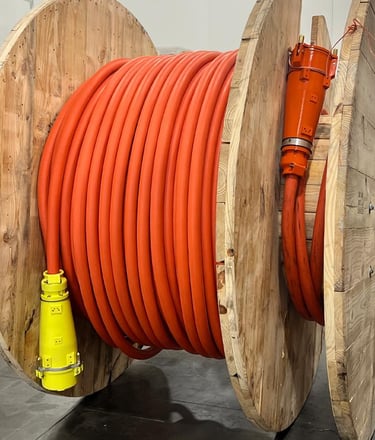
In the unforgiving operational landscapes of Australia—spanning the scorching, dust-laden open-cut iron ore pits of Western Australia’s Pilbara region, the tropical, high-humidity coal basins of Queensland’s Bowen Basin, the high-salinity salt lakes of South Australia, and the salt-encrusted coastal dredging sites of New South Wales and Western Australia—electrical distribution infrastructure faces an unrelenting barrage of mechanical, thermal, and environmental stress. Medium voltage mobile equipment, such as trailing draglines, massive electric shovels, continuous miners, high-capacity submersible dewatering pumps, and floating dredges, requires an uninterrupted, high-capacity electrical life-line. Among the specialized heavy-duty flexible supply cables deployed across global heavy industry, the German-standard (N)TSCGEWÖU cable stands out as a paramount engineering solution for high-stress reeling, trailing, and subsea or brackish water immersion applications.
Designed specifically to operate under conditions of intense physical movement, continuous motorized reeling and unreeling, sharp dynamic bending, severe crushing forces, and permanent submersion in water at hydrostatic pressures reaching depths of three hundred metres, the (N)TSCGEWÖU cable family provides an ideal combination of mechanical toughness, dielectric insulation integrity, and advanced personnel safety. Premier cable manufacturers, such as Feichun Cable, have refined these heavy-duty elastomeric cables to meet and exceed the rigorous demands of harsh Australian mining and marine operations, providing site engineers, electrical superintendents, and procurement managers with a proven, robust cable construction capable of delivering voltage ratings of 3.6/6 kV and 6/10 kV with complete reliability.
This comprehensive technical article provides an exhaustive analysis of the (N)TSCGEWÖU cable family. It examines the functional meaning behind its complex standard designation, explores its primary operational applications across Australian mining and marine installations, dissects its layered internal construction from conductor to outer sheath, details the physical and electrical mechanisms of its advanced semi-conductive shielding and grounding systems, and highlights compliance with international and Australian industrial standards.
1. What Is (N)TSCGEWÖU Cable? A Functional Designation Breakdown
Navigating the standardized naming conventions of European heavy-duty industrial cables can often present a challenge for Australian engineering teams accustomed to AS/NZS nomenclature. The designation (N)TSCGEWÖU represents a precise functional code under the German DIN VDE standard framework, specifically governed by DIN VDE 0250-813. Rather than treating this alphanumeric code as a rigid, letter-by-letter formula—as exact interpretations can vary slightly across global manufacturers—it is best understood through its functional engineering attributes and material characteristics.
The prefix letter N enclosed in parentheses indicates a cable constructed in accordance with national German standard specifications (VDE Norm), or built on established standardized principles for specialized industrial use. This letter confirms that the structural architecture, test procedures, and material formulations meet the strict baseline standards required for heavy machinery power feeds across Europe and international mining markets.
The letter T signifies a trailing or reeling cable (Trommelleitung), specifically engineered to endure continuous mechanical reeling, twisting, lateral spooling, and longitudinal tensioning across motorized drums, pulleys, payout sheaves, and trailing guides on mobile industrial machinery.
The letter combination S and C denote specialized semiconductor shielding layers and flexible copper screening. In medium voltage cable design, controlling the high-intensity electrical fields surrounding the main phase conductors is critical to preventing insulation breakdown. The presence of semiconductor tape and extruded elastomeric semi-conductive layers over both the conductor and the insulation ensures an even distribution of electrical stress throughout the dielectric material, preventing dangerous electrical stress concentrations.
The letter G refers to rubber or elastomeric insulation (Gummi), which endows the cable with superior structural flexibility, high thermal endurance, and resistance against permanent physical deformation compared to rigid thermoplastic materials such as PVC or standard polyethylene.
The letter E highlights an earth conductor arrangement, specifically designed to provide a low-impedance ground path that safely redirects fault currents away from equipment housings and operating personnel.
The letter W represents water resistance and weatherproofing (Wasserbeständig), certifying the cable's capacity for continuous, permanent immersion in fresh, salty, or brackish water environments down to three hundred metres without suffering moisture ingress or insulation degradation.
Finally, the letters Ö and U signify oil resistance (Ölbeständig) and flame retardancy/weather resistance (Umfangsbeständig / Flame Retardant), confirming that the outer sheath compound can withstand prolonged exposure to hydraulic fluids, lubricants, diesel fumes, ozone, intense ultraviolet solar radiation, and severe mechanical abrasion.
Leading cable manufacturers, including Feichun Cable, utilize this functional architecture to produce (N)TSCGEWÖU cables that deliver consistent electrical performance, extreme flexibility, and extended service life in environments where standard industrial flexible cables would experience rapid mechanical tearing, water ingress, or catastrophic electrical flashover.
2. Typical Applications Across Harsh Australian Environments
Australia’s industrial landscape presents some of the most aggressive working environments on Earth. Mobile equipment in these sectors demands trailing and supply cables that combine heavy-duty mechanical endurance with absolute electrical safety. The (N)TSCGEWÖU cable is specifically engineered for severe-duty applications where high power transmission, extreme mobility, and environmental moisture overlap.
Permanent Submersion in Salty and Brackish Water
One of the defining performance capabilities of the (N)TSCGEWÖU cable is its ability to operate under permanent immersion in salt water, brackish water, and industrial slurry pits down to hydrostatic pressures equivalent to three hundred metres of depth. In coastal dredging operations, port expansion projects, and offshore reclamation sites across Australia—such as those near Newcastle, Port Hedland, and Gladstone—floating dredgers and pontoon-mounted pumping stations rely on high-voltage power fed directly from shore or distribution barges. Standard cables quickly suffer from moisture migration through the outer sheath, leading to water treeing, insulation oxidation, and catastrophic electrical failure. The dual-sheath waterproof elastomeric barrier of (N)TSCGEWÖU prevents water ingress even under severe hydrostatic pressure and continuous tidal flexing.
Open-Cut Mining and Trailing Equipment
In the open-cut coal mines of the Hunter Valley and Bowen Basin, as well as the vast iron ore operations in Western Australia's Pilbara region, giant electric mining shovels, draglines, continuous miners, and mobile crushing units require flexible medium voltage feed cables. These trailing cables are pulled along jagged pit floors, dragged over sharp rocks, run over by service vehicles, and exposed to intense radiant heat from the sun and surrounding rock walls. The flexible design of (N)TSCGEWÖU allows it to endure continuous trailing, abrasion, and crushing forces while maintaining structural and electrical integrity.
Pontoon Pumping and Dewatering Systems
Mining operations routinely encounter vast groundwater inflows or acidic pit water accumulation that must be managed continuously. Submersible dewatering pumps mounted on floating pontoons in open pit lakes require flexible medium voltage cables that can float or hang suspended in highly mineralized, corrosive pit water. The (N)TSCGEWÖU cable provides reliable, long-term power delivery to high-capacity dewatering pumps operating in aggressive water conditions without swelling, degrading, or leaking power to ground.
Reeling Drums, Cranes, and Material Handling
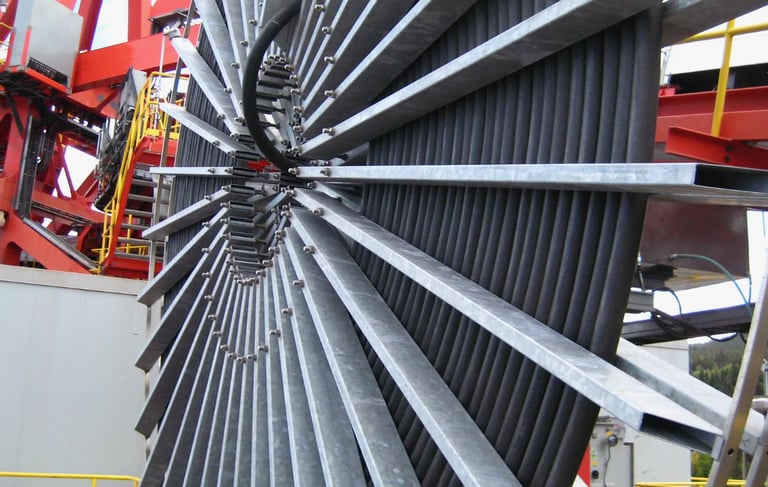
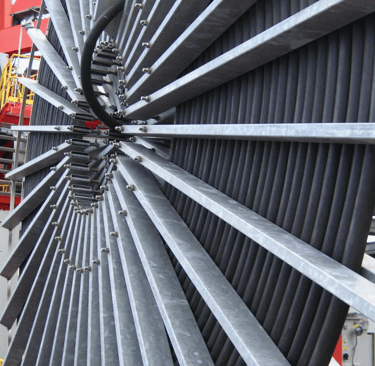
Bulk material handling facilities, gantry cranes, container stackers, and mobile stacker-reclaimers at major Australian ports utilize automated reeling drums to manage high-voltage power cables. The continuous winding, tensioning, and unwinding cycles impose intense torsional and tensile stresses on the cable structure. (N)TSCGEWÖU is constructed with flexible Class 5 fine-wire stranded conductors and a reinforced inner and outer sheath matrix that resists internal conductor twisting (corkscrewing) and tensile fatigue during rapid reeling operations.
3. Voltage and Temperature Ratings, Bending Parameters, and Dimensional Range
Engineering an electrical distribution system for heavy mobile equipment requires strict adherence to electrical ratings, thermal limits, mechanical installation parameters, and cable dimensional profiles. The (N)TSCGEWÖU cable family is manufactured across two primary voltage classes designed for medium voltage power distribution: 3.6/6 kV and 6/10 kV.
Voltage Ratings and Factory Test Standards
The notation 3.6/6 kV specifies a rated phase-to-earth voltage Uo of 3.6 kilovolts and a rated phase-to-phase voltage U of 6 kilovolts. For higher power demands, the 6/10 kV variant offers a phase-to-earth rating Uo of 6 kilovolts and a phase-to-phase rating U of 10 kilovolts. To ensure absolute dielectric integrity before field deployment, each manufactured length undergoes rigorous AC high-voltage factory testing. For the 3.6/6 kV cable class, the factory test voltage is set at 11 kilovolts, applied for five minutes. For the 6/10 kV cable class, the factory test voltage is elevated to 17 kilovolts. These high test thresholds verify that the semiconductor shielding and rubber insulation possess zero physical voids or micro-defects capable of initiating partial discharge.
Operating Temperature Profiles for Australian Conditions
Thermal management is a critical consideration in Australian industrial settings, where ambient air temperatures in remote mining regions frequently exceed 45 degrees Celsius, and surface temperatures on dark pit floors can reach above 70 degrees Celsius. The (N)TSCGEWÖU cable is engineered with high-grade elastomeric insulation and sheathing compounds capable of operating across broad thermal ranges.
In fixed, static installations, the allowable ambient operating temperature ranges from minus 40 degrees Celsius to plus 80 degrees Celsius. In dynamic, flexing, and reeling applications where the cable is under active movement and mechanical stress, the recommended operating temperature range spans from minus 25 degrees Celsius to plus 60 degrees Celsius. The maximum allowable conductor operating temperature under continuous full-load operation is 90 degrees Celsius, while short-circuit temperatures up to 250 degrees Celsius can be safely tolerated for up to five seconds without causing irreversible thermal damage to the insulation compound.
Minimum Bending Radius Guidelines
Maintaining proper bending radii is essential to prevent conductor deformation, insulation buckling, or premature outer sheath splitting. Due to its flexible Class 5 copper conductor stranding and resilient elastomeric jacket, (N)TSCGEWÖU offers exceptional bending performance. For fixed, permanent installations, the minimum permissible internal bending radius is six times the overall cable diameter. For mobile, flexed, and continuous reeling applications, the minimum bending radius increases to ten times the overall cable diameter.
Dimensional Profiles, Weights, and Mechanical Tensile Capabilities
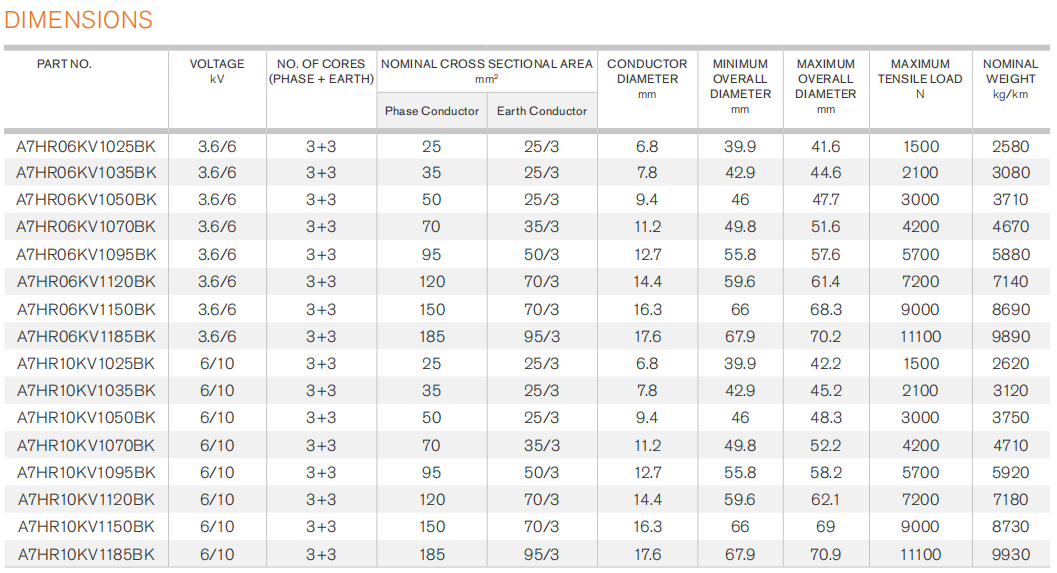
To provide procurement teams and site engineers with precise technical context, the physical cross-sectional area of phase conductors for (N)TSCGEWÖU ranges from 25 square millimetres up to 185 square millimetres. Across both 3.6/6 kV and 6/10 kV ratings, the earth conductor system utilizes a 3+3 split design, where earth cross-sections correspond proportionately to the phase core size—ranging from 25/3 square millimetres for 25 square millimetre phase cores up to 95/3 square millimetres for 185 square millimetre phase cores.
Conductor diameters range from approximately 6.8 millimetres for 25 square millimetre conductors up to 17.6 millimetres for 185 square millimetre conductors. The minimum and maximum overall diameters of completed cables range from approximately 39.9 millimetres for smaller cross-sections up to 70.9 millimetres for 185 square millimetre 6/10 kV variants. Nominal cable weights vary from approximately 2580 kilograms per kilometer for 25 square millimetre 3.6/6 kV cables up to 9930 kilograms per kilometer for 185 square millimetre 6/10 kV cables. Maximum tensile load ratings range from 1500 Newtons for 25 square millimetre cables up to 11100 Newtons for 185 square millimetre cables, illustrating the substantial mechanical tensile strength built directly into the cable geometry.
4. Comprehensive Overview of Cable Construction Architecture
The exceptional mechanical durability and electrical reliability of the (N)TSCGEWÖU cable stem directly from its highly engineered, multi-layered concentric construction. Each layer performs a specific, vital role in managing mechanical tension, resisting moisture ingress, distributing electrical fields, and facilitating safe earthing pathways.
Layer-by-Layer Architectural Breakdown
Starting from the innermost core and moving outwards to the exterior protective surface, the construction of a typical three-core plus earth (N)TSCGEWÖU cable comprises the following integral elements:
Phase Conductors: Three primary power-carrying phase cores consisting of Class 5 flexible tinned copper strands. Tinned copper provides superior oxidation resistance against moisture and corrosive atmospheric conditions.
Conductor Semi-Conductive Tape and Shield: A layer of semi-conductive tape applied over the tinned copper conductor, followed by an extruded layer of semi-conductive rubber compound. This layer eliminates air gaps between conductor strands and smoothes the internal electric field.
Main Phase Insulation: High-grade Ethylene Propylene Rubber (EPR) or equivalent high-dielectric elastomeric compound extruded cleanly over the conductor shield to provide primary voltage insulation.
Insulation Semi-Conductive Layers: An inner semi-conductive rubber layer and an outer semi-conductive layer extruded directly over the primary EPR insulation, establishing a fully shielded concentric field around each individual phase core.
Earth Conductor Assembly: Split earth conductors constructed from flexible Class 5 tinned copper strands. Instead of a single large earthing conductor, the earth conductor is divided into three equal smaller conductors placed in the outer interstices between the main phase cores.
Central Core Filler: A central elastomeric or textile filler compound, often reinforced with polyester support strands, positioned in the core center to maintain a perfectly round cable geometry and prevent structural collapse under tension or reeling pressure.
Waterproof EPR Inner Sheath: A robust inner protective jacket composed of water-impermeable Ethylene Propylene Rubber (EPR). This layer acts as a primary barrier against moisture migration, sealing the internal core assembly.
Mechanical Anti-Torsion Braid Reinforcement: Embedded between the inner sheath and outer sheath, a synthetic fiber or textile braid reinforcement provides high tensile strength and prevents severe twisting or corkscrewing when the cable is under tension on reeling drums.
Waterproof Outer Sheath: An extra-heavy-duty Chlorinated Polyethylene (CM) or polychloroprene rubber outer jacket, typically coloured black. This sheath provides extreme resistance to mechanical abrasion, tearing, chemical impact, hydraulic oil, ozone, intense solar ultraviolet radiation, and permanent water submersion.
5. Phase and Earth Conductor Design: Flexibility and Tensile Strength
The life expectancy of a trailing or reeling cable in heavy industry depends heavily on conductor engineering. In mobile applications, cables are subjected to continuous bending, severe vibration, localized crushing, and longitudinal tension. Standard rigid Class 1 solid conductors or Class 2 stranded conductors would suffer rapid metal fatigue, work hardening, and eventual strand breakage under these dynamic conditions.
Class 5 Flexible Tinned Copper Construction
To achieve the high flexibility necessary for mobile power distribution, the (N)TSCGEWÖU cable utilizes Class 5 fine-wire stranded copper conductors manufactured in strict accordance with IEC 60228 / DIN VDE 0295 standards. These conductors consist of numerous thin, highly pure copper wires bundled into smooth, pliable ropes.
Furthermore, all copper strands are individually tinned. Tinning provides two fundamental benefits: first, it creates a chemical barrier that prevents copper oxidation when exposed to moisture or corrosive atmospheric gases; second, it prevents chemical interactions between the raw copper metal and the sulfur compounds present in rubber insulation formulations during vulcanization. This ensures that the conductor remains free of corrosion and maintains low contact resistance throughout its service life.
Dynamic Mechanical Resilience in Mining and Dredging
When trailing cables are dragged behind heavy excavators or continuous miners, they experience tremendous tension and continuous localized bending. Feichun Cable engineers the conductor stranding of (N)TSCGEWÖU to maintain long-term fatigue resistance under continuous dynamic cycling. The fine wire geometry allows individual strands to slide past one another smoothly during flexing, redistributing mechanical stress evenly across the conductor bundle rather than concentrating it at a single focal point. This construction prevents the occurrence of conductor birdcaging or localized necking, ensuring steady electrical current carrying capacity even after thousands of flex cycles.
6. High-Performance Rubber Insulation Systems
In medium voltage electrical engineering, the dielectric insulation system is the most critical element preventing phase-to-phase and phase-to-earth electrical short circuits. While low voltage cables often utilize thermoplastic materials like PVC, medium voltage trailing cables require thermosetting elastomeric compounds capable of maintaining structural elasticity and high dielectric breakdown strength under elevated temperatures and harsh physical movement.
Ethylene Propylene Rubber (EPR) Characteristics
The primary insulation in the (N)TSCGEWÖU cable is formulated from advanced Ethylene Propylene Rubber (EPR) or customized elastomeric compounds. EPR is a thermosetting polymer known for its outstanding electrical, thermal, and mechanical properties. Unlike thermoplastics which soften and deform when heated, thermosetting EPR retains its physical shape and structural elasticity across extreme temperature ranges.
EPR insulation exhibits exceptionally high dielectric strength, enabling it to withstand continuous medium voltage stress without electrical breakdown. It possesses a very low dielectric loss factor (tan delta), which minimizes internal heating within the insulation layer during high-voltage operation. Additionally, EPR demonstrates outstanding inherent resistance to moisture absorption, corona discharge, and atmospheric ozone attacks.
Resistance to Thermal Aging, Moisture, and Mechanical Stress
In Australian open-cut mines and marine dredging sites, cables routinely encounter severe environmental combinations: ambient temperatures reaching 45 degrees Celsius, intense direct solar heat, high mechanical vibration, and continuous exposure to water. Under these conditions, lower-grade insulation materials undergo accelerated thermal oxidation, becoming brittle and cracking over time.
EPR rubber insulation is highly resistant to thermal aging. Even when operated continuously at its maximum rated conductor temperature of 90 degrees Celsius, EPR maintains its flexibility and elasticity over many years of service. Its low swelling characteristics when exposed to moisture ensure that water molecules cannot penetrate the insulation lattice, preventing the growth of destructive water trees—a leading cause of premature failure in solid dielectric medium voltage cables.
7. Why Shielding Is Essential in Medium Voltage Cables
A common point of inquiry among field engineers is why medium voltage cables require complex, multi-layered semi-conductive shielding systems, whereas low voltage cables utilize simple insulation over conductors. The necessity for shielding arises from fundamental electromagnetic field dynamics that manifest at operating voltages above 3 kilovolts.
Electric Field Stress Control and Vector Uniformity
When an electrical potential exceeds 3 kV, the electric field surrounding the conductor becomes extremely intense. In an unshielded multi-core cable, the electric field lines emanating from the round conductor are unevenly concentrated, particularly at the outer surfaces of the copper strands. Furthermore, in a three-phase cable, the electric fields of adjacent cores interact, creating high tangential electrical stresses across the air gaps between the insulated cores.
Air has a significantly lower dielectric breakdown strength than EPR rubber insulation. If high electrical field stress is allowed to exist in air voids between cores or between the insulation surface and outer grounding shields, the air in those gaps will ionize. This ionization process creates localized electrical discharges known as partial discharge.
Prevention of Partial Discharge and Corona Degradation
Partial discharge is a highly destructive phenomenon in medium voltage systems. Although partial discharge does not immediately trip circuit protection, it continuously emits high-frequency electrical pulses, localized heat, ultraviolet radiation, and ozone. Over time, ozone attacks the rubber insulation polymer, breaking down its molecular bonds and creating micro-cracks. Concurrently, localized heating and ion bombardment erode the EPR insulation, creating tiny carbonized channels known as electrical trees.
Eventually, an electrical tree penetrates completely through the insulation wall, resulting in a catastrophic phase-to-phase or phase-to-ground flashover failure. By incorporating extruded semi-conductive shielding over both the conductor and the main insulation surface, the (N)TSCGEWÖU cable eliminates all internal air gaps from high-stress field zones. The semiconductor layers transform the electric field into a smooth, purely radial pattern directed uniformly outward from the center of the conductor to the earth shield. This radial field distribution ensures that electrical stress is contained entirely within the high-dielectric EPR insulation, completely eliminating partial discharge and ensuring decades of safe operational performance.

8. Multi-Layered Shielding Structure in (N)TSCGEWÖU Cable
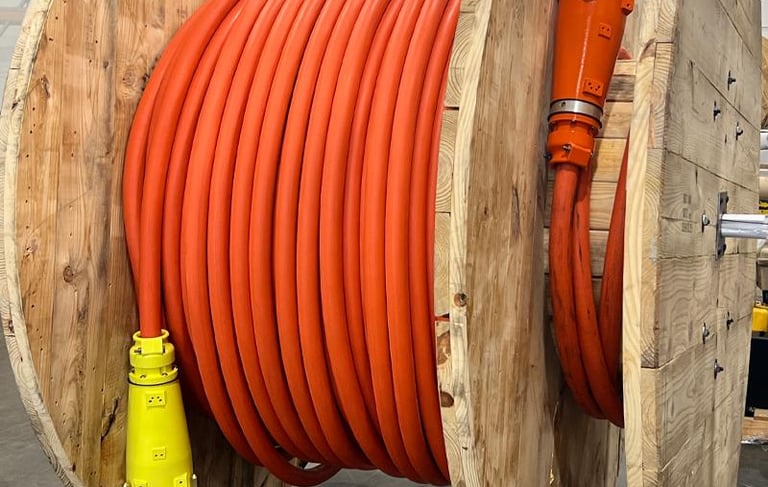
To achieve absolute electrical stress control while maintaining the physical flexibility required for trailing and reeling operations, the (N)TSCGEWÖU cable utilizes a sophisticated multi-layered semi-conductive shield arrangement surrounding each individual phase core.
Step-by-Step Architectural Breakdown of Shielding Layers
The shielding system in (N)TSCGEWÖU comprises three interrelated functional layers integrated into the core assembly:
First, a semi-conductive tape is wrapped directly over the Class 5 tinned copper conductor, followed by an extruded inner semi-conductive rubber layer. This combination smoothes out the irregular metallic profile of the individual fine copper wires, presenting a completely smooth, cylindrical conductive surface to the inner boundary of the EPR insulation.
Second, the main EPR rubber insulation is extruded directly over the inner semi-conductive layer.
Third, an outer semi-conductive rubber layer is extruded directly over the exterior surface of the EPR insulation, capped by an additional semi-conductive tape. This creates a fully enclosed, smooth cylindrical outer electrode around the insulation.
The Concentric Shield Pathway
To visualize this construction clearly, consider the radial cross-sectional path of a single phase core:
Class 5 Tinned Copper Conductor → Semi-Conductive Tape & Inner Semi-Conductive Layer → EPR Rubber Insulation → Outer Semi-Conductive Layer & Tape → Earth Conductor Contact Path → Protective Waterproof Sheath.
By maintaining continuous contact between the outer semi-conductive layer of each phase core and the surrounding earth conductors, the cable creates a zero-potential outer boundary around every phase core. Any capacitive charging current or small leakage current flowing through the insulation dielectric is instantly collected by the outer semiconductor layer and conducted safely away through the grounded earthing system.
Manufacturers such as Feichun Cable utilize advanced triple-extrusion technology, extruding the inner semiconductor, the EPR insulation, and the outer semiconductor in a single continuous process. This guarantees perfect interfacial bonding between layers with zero air ingress, maximizing partial discharge resistance and structural flexibility.
9. Grounding Architecture and Operator Safety Functions
In mining, dredging, and heavy industrial applications, electrical safety is paramount. High-voltage equipment operating in wet, outdoor, or moving environments presents severe shock hazards if an electrical fault occurs. Grounding protection in trailing cables is designed to ensure that under any fault condition—whether caused by mechanical crushing, cable cutting, or insulation breakdown—fault currents trigger immediate, automated trip responses from upstream protection relays before touch voltages reach dangerous levels on equipment frames.
Split Earth Conductor Geometry (3+3 Core Design)
A notable design feature of the (N)TSCGEWÖU cable is its symmetrical split earth conductor arrangement. Rather than placing a single large earth conductor in one interstice of the cable, which would create an asymmetrical cross-section and unbalanced weight distribution during reeling, the total required earth cross-sectional area is divided into three equal smaller conductors.
These three earth conductors are positioned symmetrically in the outer interstices formed between the three main phase cores. For instance, in a typical 3.6/6 kV cable with 70 square millimetre phase conductors, the earthing system is configured as 35/3 square millimetres—meaning three individual earth conductors, each having a cross-sectional area of approximately 11.6 square millimetres, yielding a combined total earthing capacity of 35 square millimetres.
Symmetrical Balance and Fault Path Low Impedance
This symmetrical 3+3 geometric arrangement delivers two major advantages:
Physical and Mechanical Balance: Distributing the earth copper mass evenly around the central axis creates a perfectly round, balanced cable structure. This prevents uneven torque, twist, or cable spiraling when the cable is wound onto reeling drums at high speed.
Enhanced Fault Protection and Field Symmetry: The three earth conductors sit in direct physical contact with the outer semi-conductive layers of all three phase cores along the entire length of the cable. This ensures an extremely low-impedance path to earth at any point along the cable run.
If an external object, such as a rockfall or excavator bucket, crushes the cable, the outer earth conductors make contact with the phase cores before a phase-to-phase short circuit can occur. This immediate phase-to-earth contact creates a low-resistance ground fault that instantaneously trips upstream earth-leakage circuit breakers (ELCBs) and earth fault relays, isolating power within milliseconds and preventing hazardous touch voltages from energizing the chassis of mobile machinery or surrounding water in dredging operations.
10. Heavy-Duty Mechanical Protection: Sheathing and Anti-Torsion Features
While the internal conductors, insulation, and shielding layers handle the electrical work, the sheathing system bears the brunt of physical abuse from harsh outdoor environments. In Australian open-cut mines and marine dredging channels, cables are exposed to extreme abrasion, sharp impact forces, continuous flexing, high tensile loads, hydraulic oil splatters, severe solar ultraviolet radiation, and constant moisture immersion.
Dual Rubber Waterproof Sheath Architecture
The (N)TSCGEWÖU cable relies on a heavy-duty dual-sheath construction to provide ultimate physical isolation and waterproofing:
EPR Waterproof Inner Sheath: Extruded directly over the assembled phase cores, central filler, and earth conductors, the Ethylene Propylene Rubber (EPR) inner sheath creates a tight, water-impermeable seal around the internal core matrix. This layer holds the cores firmly in position and acts as a secondary moisture barrier.
Chlorinated Polyethylene (CM) Outer Sheath: The exterior jacket is composed of high-density Chlorinated Polyethylene or heavy-duty synthetic rubber compound, finished in a high-visibility black colour. CM rubber is specifically chosen for its extraordinary resistance to mechanical abrasion, tearing, tearing propagation, cutting from sharp rocks, and impact damage. It is completely resistant to mineral oils, hydraulic fluids, grease, ozone, atmospheric oxygen, and direct solar UV exposure.
Anti-Torsion Textile Braid Reinforcement
When trailing cables are operated on high-speed reeling drums or drawn behind moving mining vehicles, they are subject to severe torsional forces (twisting). If a cable lacks internal torsional resistance, repeated twisting forces cause the outer sheath to separate from the inner cores, leading to internal core displacement known as "corkscrewing."
To prevent corkscrewing, high-quality (N)TSCGEWÖU cables incorporate a heavy-duty anti-torsion reinforcement layer embedded between the inner sheath and outer sheath. This layer consists of a high-tensile synthetic fiber braid woven in a counter-rotating spiral lattice. The braid acts as a mechanical restraint sleeve that locks the inner sheath and outer sheath together. When torsional tension is applied to the cable, the braid distributes the twisting force longitudinally along the entire cable length, maintaining structural geometry and preventing localized buckling or core twisting.
Subsea Hydrostatic Resistance Down to 300 Metres
The combination of vulcanized EPR inner sheathing, CM outer sheathing, and dense core filling enables (N)TSCGEWÖU to withstand continuous immersion in salt and brackish water at hydrostatic pressures up to 30 bar, corresponding to water depths of 300 metres. Water molecules are completely blocked from penetrating into the core spaces, ensuring that internal insulation values remain constant even after months of continuous subsea deployment on dredging heads or submersible mining pumps.
11. International Standards Compliance and Australian Industry Context
When specifying medium voltage cable systems for Australian industrial projects, engineering teams must ensure compliance with rigorous national and international standards governing cable design, electrical protection, and site safety.
Standard Families: DIN VDE 0250-813 and IEC 60502
The (N)TSCGEWÖU cable family is manufactured according to the specifications established under German standard DIN VDE 0250-813, which details design criteria, testing procedures, and material performance parameters for flexible rubber-insulated trailing and reeling cables used in heavy industry and mining.
In addition, the cable design aligns closely with broader international electrical standards, specifically IEC 60502-2 (Power cables with extruded insulation and their accessories for rated voltages from 1 kV up to 30 kV). IEC 60502 provides the international baseline for insulation thickness, shielding requirements, and high-voltage dielectric testing standards across global power distribution networks.
Alignment with Australian Mining Standards and Earth Protection Regulations
In Australia, electrical safety in mining and heavy industry is governed by strict state legislation and standards, such as AS/NZS 1802 (Electric cables - Reeling and trailing - For underground coal mining) and AS/NZS 2802 (Electric cables - Reeling and trailing - For mining and general mobile equipment).
While (N)TSCGEWÖU originates from European DIN VDE standards, its structural architecture—specifically its flexible Class 5 fine-wire tinned copper conductors, triple-extruded semi-conductive shielding, EPR insulation, and symmetrical split earth conductors (3+3 design)—directly fulfills the fundamental technical goals outlined in Australian safety regulations.
Australian electrical safety regulations emphasize zero-tolerance for partial discharge, continuous grounding monitoring, and rapid earth-fault protection tripping to prevent touch-voltage hazards on trailing cables. The robust 3+3 earthing geometry of (N)TSCGEWÖU provides an ideal physical structure for integration into Australian earth-continuity monitoring systems and core-balance earth leakage protection schemes commonly implemented across Pilbara iron ore operations, Bowen Basin open-cut coal mines, and NSW marine dredging projects.
12. Equipment Application Matrix: Field Deployment Scenarios
To help engineers, maintenance superintendents, and procurement teams visualize the operational versatility of the (N)TSCGEWÖU cable family, the following section details key heavy machinery and equipment integration scenarios across Australian mine sites and marine facilities.
Open-Cut Mining Shovels, Excavators, and Draglines
In open-cut mining pits, electric shovels and massive excavators require uninterrupted high-voltage feeds to operate heavy hydraulic systems and winch drives. Powered via trailing cables laid directly across pit roads and rough rock floors, these machines subject supply lines to constant dragging, crushing, and high solar heat. The (N)TSCGEWÖU cable provides the necessary tensile strength, abrasion resistance, and thermal tolerance to handle continuous trailing behind primary production shovels without suffering outer jacket tears or conductor strand fatigue.
Submersible Pumps, Pontoons, and Pit Dewatering Systems
Groundwater management is an ongoing challenge in Australian opencast mining. High-capacity submersible dewatering pumps are deployed on floating pontoons in pit lakes, pumping highly mineralized, acidic, or brackish water out of working zones. (N)TSCGEWÖU is uniquely qualified for this application because its waterproof EPR inner sheath and CM outer sheath prevent water ingress under continuous immersion at high pressure, while its flexibility accommodates pontoon movement caused by changing water levels and wind action.
Marine Dredges, Floating Docks, and Coastal Reclamation
Marine dredging vessels and floating dry docks engaged in harbor maintenance, port deepening, and sand reclamation require flexible medium voltage feed lines running from shore-based sub-stations to shipboard distribution boards. These cables sit in salt water, endure wave flexing, and are exposed to harsh coastal UV rays. The water-resistant elastomeric construction of (N)TSCGEWÖU guarantees zero degradation under salt water immersion up to 300 metres depth, preventing dielectric breakdown caused by salt-water treeing.
Continuous Miners, Tunneling Machines, and Mobile Crushers
In underground mining, civil tunneling projects, and mobile crushing plants, machinery moves continuously within confined, high-vibration spaces. Space limitations demand tight bending radii, while high power consumption requires 3.6/6 kV or 6/10 kV voltage delivery. The Class 5 flexible conductor design and compact concentric construction of (N)TSCGEWÖU enable tight bending radii (6xD fixed, 10xD flexed) without compromising dielectric shielding or structural integrity.
Reeling Drums on Stacker-Reclaimers and Gantry Cranes
Automated reeler systems on bulk stacker-reclaimers and container gantry cranes subject power cables to thousands of continuous reeling and unwinding cycles per month. The anti-torsion textile braid embedded within the (N)TSCGEWÖU outer structure locks the inner and outer sheaths together, preventing cable twisting, corkscrewing, and internal shield displacement during rapid drum reeling.
Technical Appendix & Procurement Specifications
When specifying (N)TSCGEWÖU cables for Australian site deployments, procurement officers should verify manufacturer compliance with key technical benchmarks. The operational capabilities below summarize essential technical metrics for engineering review:
Nominal Voltage Class Options: 3.6/6 kV and 6/10 kV
AC Factory Test Voltages: 11 kV (for 3.6/6 kV class) and 17 kV (for 6/10 kV class)
Fixed Ambient Thermal Range: minus 40 degrees Celsius to plus 80 degrees Celsius
Flexed / Reeling Thermal Range: minus 25 degrees Celsius to plus 60 degrees Celsius
Maximum Conductor Operating Temperature: 90 degrees Celsius continuous
Short-Circuit Conductor Limit: 250 degrees Celsius for five seconds
Minimum Static Bending Radius: 6 times overall cable diameter
Minimum Dynamic Reeling Bending Radius: 10 times overall cable diameter
Immersion Depth Resistance: Permanent subsea or brackish immersion down to 300 metres depth
Standard Sheath Colour: High-visibility black UV-resistant CM compound
Phase Conductor Construction: Class 5 fine-wire stranded tinned copper
Earthing Topology: 3+3 symmetrical split tinned copper earthing cores
Shielding Architecture: Triple-extruded semi-conductive inner and outer layers over EPR insulation
By partnering with experienced, specialized manufacturers such as Feichun Cable, Australian operations ensure that their medium voltage reeling and trailing cables deliver maximum uptime, superior mechanical fatigue life, and complete operational safety under the harshest site conditions on the planet.
Conclusion: Specifying (N)TSCGEWÖU for Uncompromising Industrial Performance
In harsh industrial environments where high mechanical stress, continuous movement, and deep water immersion intersect with medium voltage power distribution, cable failure is not merely an inconvenience—it represents costly production downtime, severe equipment damage, and significant safety risks for site personnel.
The (N)TSCGEWÖU cable family engineered by manufacturers like Feichun Cable provides a comprehensive, highly reliable solution to these challenges. By combining Class 5 flexible tinned copper conductors, high-dielectric EPR rubber insulation, advanced triple-extruded semi-conductive field stress shielding, a balanced 3+3 split earthing architecture, and a heavy-duty waterproof CM outer sheath with anti-torsion reinforcement, (N)TSCGEWÖU delivers exceptional electrical performance and mechanical resilience.
Whether deployed on a floating dredge in coastal New South Wales, an open-cut mining shovel in the Pilbara, a dewatering pontoon in the Bowen Basin, or an automated stacker-reclaimer in a major port facility, (N)TSCGEWÖU cable construction stands as a benchmark of engineering excellence—ensuring safe, reliable, and continuous heavy-duty power delivery across the toughest industrial applications in Australia and worldwide.
How to Reach Us
Get in Touch
SiteMap
Product Catalogue
Festoon Cable
Shore Power Cable


Scan to add us on WeChat