
Engineering Manual for High-Performance NSHTÖU Heavy-Duty Rubber Reeling Cables
NSHTÖU heavy-duty rubber drum reeling cable guide covering DIN VDE naming, construction, electrical and mechanical performance, and applications in cranes, port equipment and mining reeling systems for OEMs and engineers.
hongjing.Wang@Feichun
7/20/202619 min read
1. Introduction: Role and Critical Functions of NSHTÖU Cables
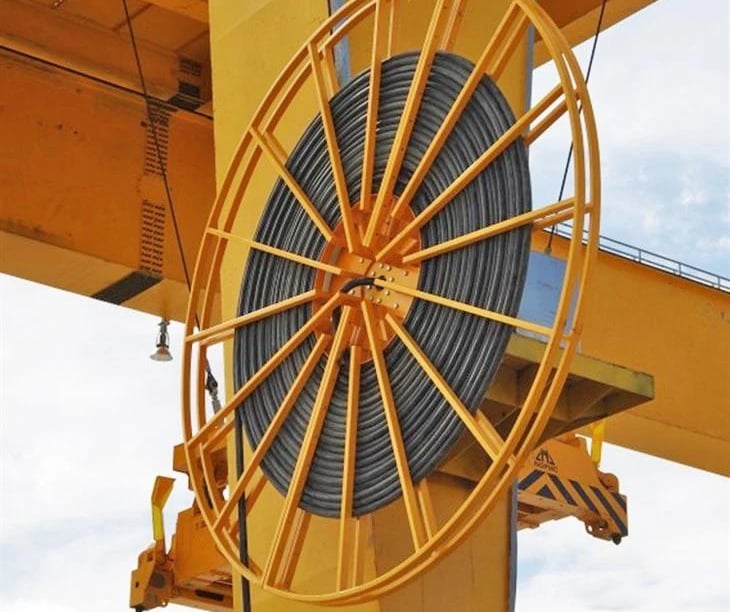
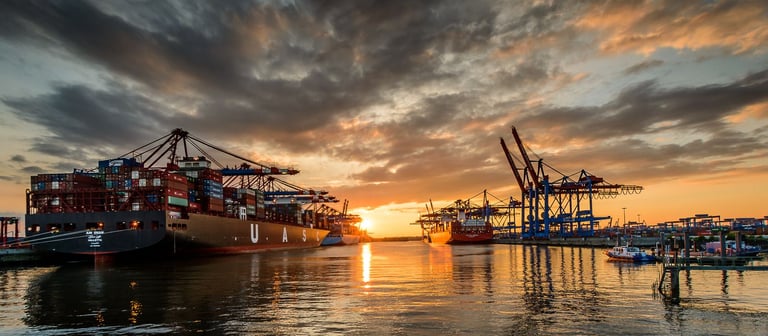
In modern industrial logistics, maritime container handling, and bulk raw material extraction, heavy mobile machinery relies heavily on uncompromised electrical energy delivery and real-time control feedback. Heavy-duty rubber reeling cables designated as NSHTÖU represent the absolute pinnacle of dynamic electrical engineering, designed specifically to operate on motor-driven cable reels, spring-operated drums, force-guided roller trains, and mobile hawser systems. Operating environments across the Middle East and Gulf Cooperation Council (GCC) regions present some of the most aggressive physical challenges found anywhere on earth. Facilities such as DP World Jebel Ali Port, Khalifa Port in Abu Dhabi, King Abdulaziz Port in Dammam, and vast open-pit mining operations in the Arabian Peninsula subject cable infrastructure to relentless ambient temperatures exceeding 50 ℃, direct solar ultraviolet (UV) radiation, severe silica dust abrasion, and highly corrosive marine salt spray.
Under these brutal operational conditions, standard commercial rubber or PVC flexible cables quickly suffer from severe physical failure modes, including jacket cracking, thermal degradation, conductor fatigue, internal core birdcaging, and disastrous torsional twisting. The NSHTÖU heavy-duty reeling cable engineered by Feichun is specifically constructed to withstand intense multi-axial mechanical forces. As a reel spools in and out, the cable experiences simultaneous tension, extreme reverse-bending fatigue, high radial crushing pressure across drum layers, and high-speed directional changes at speeds reaching 2 m/s or higher. Feichun NSHTÖU cables integrate specialized fine-stranded conductors, elastomeric insulation compounds, internal stress-relieving center cores, anti-torsion textile braids, and robust chloroprene outer sheaths. This intricate internal architecture ensures uninterrupted power transmission up to 0.6/1 kV and reliable control signal integrity across thousands of continuous operational spooling cycles.
This technical engineering manual is authored for senior project procurement managers, electrical design engineers, crane manufacturers (OEMs), port automation specialists, mining equipment suppliers, and maintenance superintendents. By establishing a rigorous engineering framework, this guide explores the structural mechanics, material science, thermal ampacity derating calculations, and comparative advantages of Feichun NSHTÖU cables. It serves to empower technical decision-makers in selecting optimal cable specifications, ensuring long-term operational uptime, reducing total cost of ownership (TCO), and avoiding unscheduled downtime across mission-critical heavy machinery operations.
2. NSHTÖU Naming Conventions and International Standards
2.1 German DIN VDE Designation Background
The alphanumeric designation system governed by the German Institute for Standardization (DIN) and the Association for Electrical, Electronic & Information Technologies (VDE) provides an unambiguous, standardized taxonomy for specialty industrial cables. Under DIN VDE 0250 Part 814, specific constructional, mechanical, and material criteria are mandated for heavy-duty rubber flexible cables intended for mobile reeling applications. Unlike standard flexible cords designed for light portable tools or stationary building power, DIN VDE flexible reeling standards dictate precise physical thresholds regarding tensile strength, abrasion resistance, ozone stability, and dynamic flexural fatigue.
Feichun manufactures its complete line of NSHTÖU cables strictly in accordance with DIN VDE 0250-814 standards, while simultaneously aligning with international harmonization norms such as IEC 60228 for conductor stranding, IEC 60332-1-2 for flame retardancy, and IEC 60811 for elastomeric material testing. Adhering to these strict German and European benchmarks ensures that Feichun NSHTÖU cables offer absolute interchangeability and equivalent performance when replacing European OEM factory-fitted cables on imported quay cranes, rubber-tyred gantry cranes, and mining stacker-reclaimers.
2.2 Deciphering the Letter Code: N S H T Ö U
Each letter within the standardized NSHTÖU designation reveals a vital structural attribute, detailing the internal geometry and material formulation engineered by Feichun:
N (National Standard): Designates that the cable structure is manufactured in full compliance with the German DIN VDE standard framework for standardized electrical machinery and power distribution cables.
S (Heavy-Duty / Dynamic Movement): Indicates a heavy-duty flexible construction engineered specifically for severe mechanical stress, continuous movement, high-velocity dynamic flexing, and heavy industrial duty cycles.
H (Harmonized Rubber Insulation): Represents high-grade harmonized synthetic rubber insulation applied over the conductors. In Feichun NSHTÖU designs, this corresponds to advanced Ethylene Propylene Rubber (EPR) compound Type 3G13 according to VDE 0207 Part 20, providing exceptional dielectric strength and high thermal capacity.
T (Textile Reinforced / Drum Reeling Construction): Signifies special structural provisions designed for drum reeling service. This includes an integrated textile anti-torsion braid embedded between the inner bedding and outer jacket, as well as high-tensile internal support elements designed to absorb axial pulling tension during spooling.
Ö (Oil Resistant Outer Sheath): Denotes an oil-resistant elastomeric outer sheath formulated from premium Chloroprene Rubber (CR) compound Type 5GM3 according to VDE 0207 Part 21. This protects the cable from mineral oils, gear lubricants, hydraulic fluids, and diesel fuel spills.
U (Flame Retardant and Weather/UV Resistant for Mobile Use): Confirms that the outer sheath compound is flame retardant (self-extinguishing), highly resistant to atmospheric weather effects, intense ultraviolet radiation, and extreme ozone exposure, rendering the cable fully suitable for mobile outdoor reeling applications in extreme harsh outdoor environments.
2.3 Variant Designations: NSHTÖU, (N)SHTÖU, NSHTÖU-J, and NSHTÖU-O
Throughout international technical specifications, engineers frequently encounter minor variations in cable notation. Understanding these subtleties is crucial to preventing costly specification errors during project procurement:
NSHTÖU vs (N)SHTÖU: Standard NSHTÖU directly denotes full certified compliance with DIN VDE 0250-814. The prefix notation (N)SHTÖU is commonly utilized by manufacturers to indicate a heavy-duty reeling cable constructed based on or closely adhering to the VDE 0250-814 design philosophy, incorporating enhanced proprietary material upgrades (such as high-temperature HEPR insulation or extra-tough sheathing) that meet or exceed standard VDE performance benchmarks. Feichun supplies both fully certified standard NSHTÖU and custom-enhanced (N)SHTÖU engineered for ultra-severe Middle Eastern climate demands.
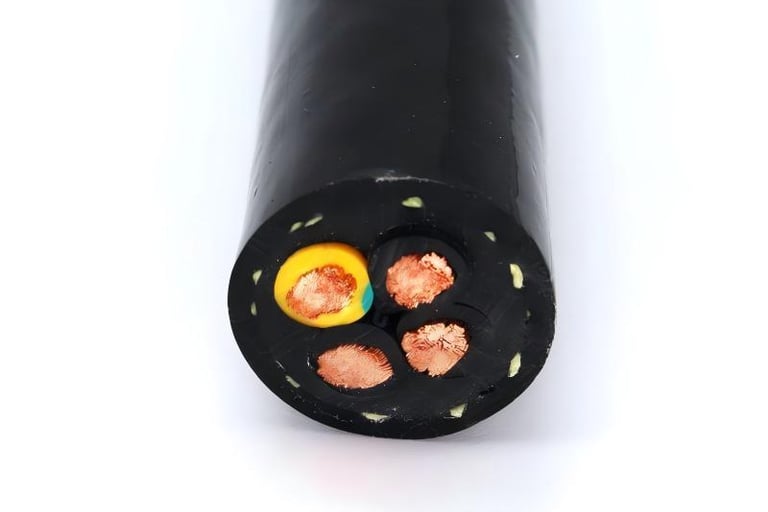
NSHTÖU-J: The letter suffix "J" signifies the inclusion of a dedicated protective earth conductor (green/yellow color insulation) within the multi-core cable assembly. In 4-core power variants (NSHTÖU-J 4G), the core color coding consists of Green/Yellow, Black, Grey, and Brown. In 5-core configurations (NSHTÖU-J 5G), the cores are Green/Yellow, Black, Blue, Brown, and Grey. For multi-core control cables (such as 12G, 18G, 24G, 30G, 42G, or 45G 1.5 mm² or 2.5 mm²), the "J" structure includes one green/yellow ground core alongside black cores printed with white consecutive numerals (1 to N).
NSHTÖU-O: The letter suffix "O" explicitly denotes a multi-core cable constructed without a dedicated green/yellow protective earth conductor. All cores serve as active phase or control conductors. For example, a 4-core NSHTÖU-O power cable contains Grey, Brown, Black, and Blue cores. NSHTÖU-O configurations are commonly deployed in isolated three-phase delta systems, secondary control loops, or specialized DC crane power circuits.
Feichun strongly advises consulting engineering datasheets prior to ordering to verify ground conductor presence, core color coding, overall outer diameter tolerances, and net weight specifications, thereby ensuring seamless mechanical fitting on existing reel guides and slip ring assemblies.
3. In-Depth Cable Construction and Material Science
3.1 Conductor Architecture and Metallurgy
The primary electrical heart of the Feichun NSHTÖU cable comprises ultra-flexible Class 5 stranded copper conductors manufactured strictly in accordance with IEC 60228 and VDE 0295 standards. To achieve the supreme flexural fatigue resistance demanded by continuous spooling, Feichun utilizes pure, high-purity electrolytic copper drawn into micro-fine individual wire strands. For example, in a 1.5 mm² or 2.5 mm² conductor, individual strand diameters do not exceed 0.26 mm, whereas in larger power cross-sections ranging from 4 mm² up to 150 mm², maximum strand diameters are strictly controlled between 0.31 mm and 0.51 mm.
For applications situated in aggressive coastal and marine environments—such as container terminals along the Persian Gulf and Red Sea—Feichun provides high-grade tinned copper conductors as a standard or optional upgrade. The protective metallic tin coating forms an impermeable chemical barrier over the copper surface, completely preventing oxidation, green patina formation, and chemical degradation caused by hydrogen sulfide, moisture ingress, and airborne salt ions. Furthermore, individual copper strands are twisted together using engineered lay pitches designed to minimize internal friction and prevent wire buckling during dynamic high-speed reeling cycles.
Key conductor parameters across common Feichun NSHTÖU power sizes include:
1.5 mm² Conductor: Maximum individual wire diameter of 0.26 mm; Maximum DC resistance at 20 ℃ (tinned/coated) = 13.7 ohms/km.
2.5 mm² Conductor: Maximum individual wire diameter of 0.26 mm; Maximum DC resistance at 20 ℃ (tinned/coated) = 8.21 ohms/km.
4 mm² Conductor: Maximum individual wire diameter of 0.31 mm; Maximum DC resistance at 20 ℃ (tinned/coated) = 5.09 ohms/km.
6 mm² Conductor: Maximum individual wire diameter of 0.31 mm; Maximum DC resistance at 20 ℃ (tinned/coated) = 3.39 ohms/km.
10 mm² Conductor: Maximum individual wire diameter of 0.41 mm; Maximum DC resistance at 20 ℃ (tinned/coated) = 1.95 ohms/km.
16 mm² Conductor: Maximum individual wire diameter of 0.41 mm; Maximum DC resistance at 20 ℃ (tinned/coated) = 1.24 ohms/km.
25 mm² Conductor: Maximum individual wire diameter of 0.41 mm; Maximum DC resistance at 20 ℃ (tinned/coated) = 0.795 ohms/km.
35 mm² Conductor: Maximum individual wire diameter of 0.41 mm; Maximum DC resistance at 20 ℃ (tinned/coated) = 0.565 ohms/km.
50 mm² Conductor: Maximum individual wire diameter of 0.41 mm; Maximum DC resistance at 20 ℃ (tinned/coated) = 0.393 ohms/km.
70 mm² Conductor: Maximum individual wire diameter of 0.51 mm; Maximum DC resistance at 20 ℃ (tinned/coated) = 0.277 ohms/km.
95 mm² Conductor: Maximum individual wire diameter of 0.51 mm; Maximum DC resistance at 20 ℃ (tinned/coated) = 0.210 ohms/km.
120 mm² Conductor: Maximum individual wire diameter of 0.51 mm; Maximum DC resistance at 20 ℃ (tinned/coated) = 0.164 ohms/km.
150 mm² Conductor: Maximum individual wire diameter of 0.51 mm; Maximum DC resistance at 20 ℃ (tinned/coated) = 0.132 ohms/km.
3.2 Insulation Material Science: EPR and HEPR Rubber Compounds
Electrical insulation in Feichun NSHTÖU cables is formed from advanced Ethylene Propylene Rubber (EPR Type 3G13 according to VDE 0207 Part 20) or high-modulus Hard Grade EPR (HEPR). Unlike thermoplastic materials like PVC, which become soft and susceptible to deformation under elevated operating temperatures, cross-linked elastomeric EPR remains thermally stable and physically robust up to a maximum continuous conductor operating temperature of 90 ℃, with short-circuit temperature thresholds extending up to 250 ℃.
The EPR rubber insulation is entirely halogen-free, exhibiting exceptional resistance to electrical treeing, partial discharge, corona effects, and moisture absorption. In dynamic reeling service, insulation flexibility is paramount. Feichun EPR compounds retain complete elasticity across extreme thermal gradients, supporting flexible dynamic operation from -25 ℃ up to +80 ℃ ambient, and fixed static installation down to -40 ℃. The standard operating voltage rating for all Feichun NSHTÖU power and control cables is rated at U₀/U = 0.6/1 kV (600/1000 V AC), providing a robust safety margin for industrial low-voltage power distribution networks.
3.3 Inner Bedding, Synthetic Fillers, and Torsional Anti-Twist Braid
Maintaining structural roundness and mechanical equilibrium inside a reeling cable subjected to severe spooling tension requires precise internal architecture. Feichun constructs NSHTÖU cables with an optimized multi-tier core support structure:
Center Support Member & Fillers: A high-tensile textile polyester central support core or elastomeric EPR center filler (Type 3G13 on polyester matrix) is positioned at the geometric axis of the cable. Synthetic rubber fillers are laid in the interstices between insulated phase conductors to form a perfectly circular, compact bundle, preventing core collapse or migration under severe radial compression.
Heavy-Duty Inner Bedding: Encapsulating the insulated core assembly is a robust inner rubber sheath or bedding layer formed from synthetic rubber compound Type GM1b according to VDE 0207 Part 21. This bedding serves as a protective mechanical cushion, absorbing external crushing forces and insulating the inner core assembly from multi-axial shear stresses.
Anti-Torsion Polyester Braiding: Embedded directly between the inner bedding and outer chloroprene jacket is a high-strength open-mesh braid constructed from heavy-duty polyester threads. This anti-torsion braid acts as an integral mechanical sheath tie. When the cable is subjected to axial pulling forces or rotational torque during spooling, the polyester braid locks the inner bedding and outer jacket together, preventing relative rotation, jacket detachment, and corkscrewing failure modes.
3.4 Premium Chloroprene Rubber (CR) Outer Sheath
The outer jacket of the Feichun NSHTÖU cable represents the primary defense line against environmental and mechanical destruction. Formulated from premium Chloroprene Rubber (CR compound Type 5GM3 according to VDE 0207 Part 21), the sheath is specifically engineered for high tear propagation strength, extreme wear resistance, and long-term durability under continuous sliding abrasion against guide rollers and metal drum flanges.
The chemical composition of Feichun heavy-duty Chloroprene outer sheaths yields exceptional resistance to mineral oils, synthetic gear lubricants, hydraulic fluids, grease, diesel fuel, mild acids, and industrial alkalis in accordance with BS EN/IEC 60811-2-1 testing standards. Furthermore, the black chloroprene matrix is heavily fortified with micro-fine carbon black particles, conferring immunity against solar ultraviolet radiation, intense ozone degradation, and severe atmospheric exposure in scorching desert climates. The sheath formulation is inherently self-extinguishing and flame retardant, satisfying the rigid safety requirements of IEC 60332-1-2.
4. Electrical Specifications and Thermal Derating Mechanics
4.1 Standard Voltage Ratings and High-Voltage Dielectric Testing
Feichun NSHTÖU cables are engineered for standard low-voltage distribution and control applications with nominal voltage ratings defined as follows:
Nominal AC Voltage (U₀/U): 0.6/1 kV (600 V conductor-to-earth / 1000 V conductor-to-conductor).
Maximum Permissible Continuous AC Voltage (Umax): Up to 1.2 kV across phase conductors.
Maximum Permissible DC Voltage System Operating Limit: Up to 0.9 kV conductor-to-earth, or 1.8 kV conductor-to-conductor in isolated DC circuits.
Factory Dielectric AC Test Voltage: Every manufactured length of Feichun NSHTÖU cable undergoes rigorous routine factory testing at 3.5 kV AC for 5 continuous minutes, verifying absolute insulation integrity and breakdown resistance.
4.2 Current-Carrying Capacity and Environmental Thermal Derating
The current capacity (ampacity) of a cable dictates the maximum electrical power it can continuously transmit without exceeding its upper conductor thermal limit of 90 ℃. Standard international tables (such as VDE 0298-4 and IEC 60364-5-52) provide baseline ampacity values calculated for a single cable lying freely in open air at an ambient reference temperature of 30 ℃. However, in real-world Middle Eastern industrial deployments, ambient temperatures routinely reach 50 ℃ to 55 ℃, and cables wound on multi-layer motor drums suffer from severe thermal entrapment. Design engineers must apply precise thermal derating correction factors to prevent overheating, insulation breakdown, and premature cable failure.
Base current-carrying capacity for Feichun NSHTÖU cables at 30 ℃ reference ambient temperature in open air and on single-layer reels:
1.5 mm² Conductor: Free air ampacity = 25 A; In conduit ampacity = 24 A; Single-layer reeled ampacity = 19 A.
2.5 mm² Conductor: Free air ampacity = 32 A; In conduit ampacity = 30 A; Single-layer reeled ampacity = 24 A.
4 mm² Conductor: Free air ampacity = 43 A; In conduit ampacity = 41 A; Single-layer reeled ampacity = 33 A.
6 mm² Conductor: Free air ampacity = 56 A; In conduit ampacity = 53 A; Single-layer reeled ampacity = 42 A.
10 mm² Conductor: Free air ampacity = 78 A; In conduit ampacity = 74 A; Single-layer reeled ampacity = 59 A.
16 mm² Conductor: Free air ampacity = 104 A; In conduit ampacity = 99 A; Single-layer reeled ampacity = 79 A.
25 mm² Conductor: Free air ampacity = 138 A; In conduit ampacity = 131 A; Single-layer reeled ampacity = 105 A.
35 mm² Conductor: Free air ampacity = 170 A; In conduit ampacity = 162 A; Single-layer reeled ampacity = 130 A.
50 mm² Conductor: Free air ampacity = 212 A; In conduit ampacity = 202 A; Single-layer reeled ampacity = 162 A.
70 mm² Conductor: Free air ampacity = 263 A; In conduit ampacity = 250 A; Single-layer reeled ampacity = 200 A.
95 mm² Conductor: Free air ampacity = 316 A; In conduit ampacity = 301 A; Single-layer reeled ampacity = 241 A.
120 mm² Conductor: Free air ampacity = 370 A; In conduit ampacity = 352 A; Single-layer reeled ampacity = 282 A.
150 mm² Conductor: Free air ampacity = 424 A; In conduit ampacity = 404 A; Single-layer reeled ampacity = 323 A.
4.3 Temperature Derating Multipliers for High Ambient Conditions
When operating in ambient temperatures exceeding the baseline 30 ℃ standard, the nominal allowable current must be multiplied by the following environmental thermal correction factor (f1):
Ambient Air Temperature 30 ℃: Correction factor f1 = 1.00
Ambient Air Temperature 35 ℃: Correction factor f1 = 0.96
Ambient Air Temperature 40 ℃: Correction factor f1 = 0.91
Ambient Air Temperature 45 ℃: Correction factor f1 = 0.87
Ambient Air Temperature 50 ℃: Correction factor f1 = 0.82
Ambient Air Temperature 55 ℃: Correction factor f1 = 0.76
Ambient Air Temperature 60 ℃: Correction factor f1 = 0.71
Ambient Air Temperature 65 ℃: Correction factor f1 = 0.65
4.4 Multi-Layer Reel Spooling Thermal Derating Multipliers
When a reeling cable is spooled onto a motorized drum in multiple overlapping layers, thermal dissipation is severely restricted. Inner cable layers become trapped beneath outer layers, leading to rapid heat accumulation. Design engineers must apply the multi-layer drum derating factor (f2) to determine safe operational ampacity:
Single Layer on Reel (1 Layer): Drum derating factor f2 = 0.80 (or 80% of open-air rating).
Two Layers on Reel (2 Layers): Drum derating factor f2 = 0.60 (or 60% of open-air rating).
Three Layers on Reel (3 Layers): Drum derating factor f2 = 0.49 (or 49% of open-air rating).
Four Layers on Reel (4 Layers): Drum derating factor f2 = 0.41 (or 41% of open-air rating).
Practical Worked Calculation Example: Consider a container gantry crane operating at Mina Zayed Port in Abu Dhabi during summer peak ambient conditions of 50 ℃. The power supply uses a Feichun NSHTÖU 4x25 mm² cable spooled on a motorized 2-layer cylindrical drum reel. Baseline open-air ampacity at 30 ℃ for 25 mm² is 138 Amps. Applying ambient temperature factor f1 = 0.82 (for 50 ℃) and drum layering factor f2 = 0.60 (for 2 layers):
Allowable Safe Ampacity = Base Ampacity (138 A) × f1 (0.82) × f2 (0.60) = 67.89 Amps.
This engineered calculation clearly illustrates that a cable rated for 138 Amps under standard laboratory conditions can safely carry only 67.89 Amps under real-world Middle East port drum reeling conditions. Oversizing cross-sections during project design is vital to preventing thermal burnout.
5. Mechanical Performance, Tensile Dynamics, and System Integration
5.1 Minimum Bending Radii and Geometrical Dimensions
Strict adherence to minimum bending radius guidelines is essential to prevent permanent mechanical deformation of copper strands and severe insulation shear. In cable engineering, minimum bending radius is defined as a direct multiple of the cable's overall outer diameter (D):
Fixed Static Installation: Minimum bending radius = 4 × D (4 times the total outer diameter).
Dynamic Flexing / Free Movement: Minimum bending radius = 5 × D (5 times the total outer diameter).
Motorized Drum Reeling & Sheave Spooling: Minimum bending radius = 5 × D to 7.5 × D, depending on linear reeling velocity and guide roller configuration.
Dimensional specifications across selected Feichun NSHTÖU configurations demonstrate how overall outer diameter (D) scales with core count and conductor area:
NSHTÖU 4x1.5 mm²: Nominal overall diameter = 14.6 mm; Nominal cable weight = 295 kg/km.
NSHTÖU 4x2.5 mm²: Nominal overall diameter = 16.2 mm; Nominal cable weight = 370 kg/km.
NSHTÖU 4x4 mm²: Nominal overall diameter = 19.3 mm; Nominal cable weight = 520 kg/km.
NSHTÖU 4x6 mm²: Nominal overall diameter = 21.7 mm; Nominal cable weight = 690 kg/km.
NSHTÖU 4x10 mm²: Nominal overall diameter = 25.9 mm; Nominal cable weight = 1025 kg/km.
NSHTÖU 4x16 mm²: Nominal overall diameter = 29.1 mm; Nominal cable weight = 1305 kg/km.
NSHTÖU 4x25 mm²: Nominal overall diameter = 34.4 mm; Nominal cable weight = 2070 kg/km.
NSHTÖU 4x35 mm²: Nominal overall diameter = 38.6 mm; Nominal cable weight = 2740 kg/km.
NSHTÖU 4x50 mm²: Nominal overall diameter = 45.0 mm; Nominal cable weight = 3790 kg/km.
NSHTÖU 4x70 mm²: Nominal overall diameter = 51.0 mm; Nominal cable weight = 5356 kg/km.
NSHTÖU 4x95 mm²: Nominal overall diameter = 60.6 mm; Nominal cable weight = 7018 kg/km.
NSHTÖU 4x120 mm²: Nominal overall diameter = 63.5 mm; Nominal cable weight = 8220 kg/km.
NSHTÖU 4x150 mm²: Nominal overall diameter = 66.5 mm; Nominal cable weight = 8905 kg/km.
NSHTÖU 5x1.5 mm²: Nominal overall diameter = 15.6 mm; Nominal cable weight = 340 kg/km.
NSHTÖU 5x2.5 mm²: Nominal overall diameter = 18.6 mm; Nominal cable weight = 490 kg/km.
NSHTÖU 5x16 mm²: Nominal overall diameter = 31.7 mm; Nominal cable weight = 1745 kg/km.
NSHTÖU 12x1.5 mm²: Nominal overall diameter = 21.3 mm; Nominal cable weight = 630 kg/km.
NSHTÖU 18x2.5 mm²: Nominal overall diameter = 28.2 mm; Nominal cable weight = 1195 kg/km.
NSHTÖU 24x2.5 mm²: Nominal overall diameter = 33.0 mm; Nominal cable weight = 1565 kg/km.
NSHTÖU 30x2.5 mm²: Nominal overall diameter = 34.6 mm; Nominal cable weight = 1830 kg/km.
NSHTÖU 45x2.5 mm²: Nominal overall diameter = 43.8 mm; Nominal cable weight = 2863 kg/km.
5.2 Tensile Strength, Pulling Limits, and Hardware Strain Relief
When a reeling cable is continuously wound and unwound under motor torque, significant longitudinal tensile forces act directly upon the copper conductors and sheathing layers. To prevent plastic necking or conductor snapping, maximum tensile stress limits must be strictly observed during system design:
Maximum Allowable Conductor Tensile Stress: Standard maximum permissible tensile stress acting on copper conductors during continuous spooling is rated at 15 N per mm² of total copper cross-section (15 N/mm²).
Tensile Load Calculation Formula: Max Tensile Force (N) = Total Copper Area (mm²) × 15 N/mm². For example, for a 4x25 mm² cable, total copper area = 3 × 25 mm² = 75 mm² (excluding ground or including total active power conductors). Max Permissible Tension = 75 mm² × 15 N/mm² = 1125 Newtons.
Strain Relief Hardware Requirements: At the cable anchoring point on the crane structure or drum core, mechanical strain relief grips (Kellems wire mesh grips or heavy-duty wedge clamps) must be installed. Direct tension must never be transferred to electrical terminal blocks or slip ring connections.
5.3 Reeling Speed, Dynamic Velocity, and Spooling Geometry
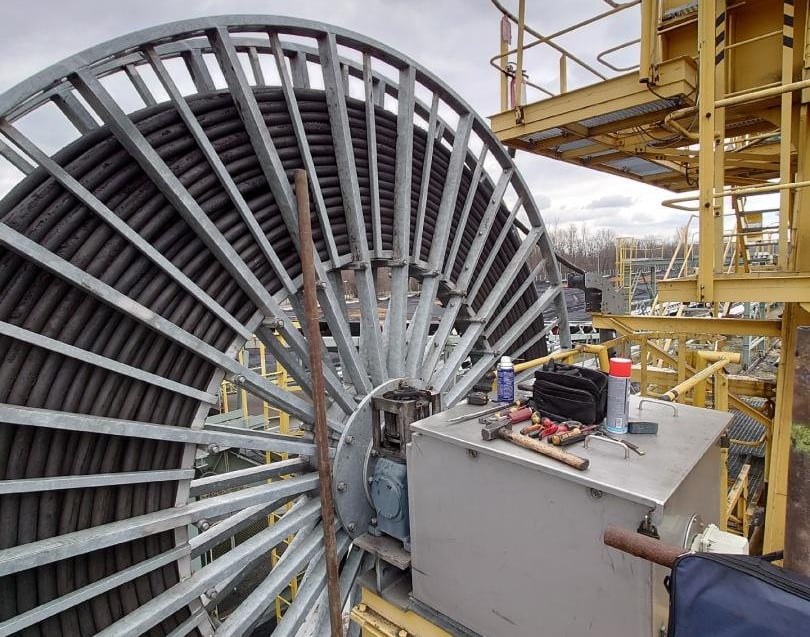
Feichun NSHTÖU cables are engineered for high-speed dynamic reeling systems capable of operating at continuous spooling velocities up to 2 m/s (120 meters per minute). Achieving long flexural service life at elevated travel speeds depends heavily on mechanical reel arrangement:
Mono-Spiral Reels: Wind the cable in a single flat coil layer between narrow flanges. This arrangement provides superior heat dissipation and precise cable alignment, making it the preferred choice for high-speed port cranes.
Cylindrical Multi-Layer Drums: Wind the cable in multiple helical layers across a wide drum width. While highly compact, multi-layer drums increase internal crushing stress and thermal entrapment, requiring rigorous application of derating factors.
Guide Rollers and Bell Mouths: Cable entry guide funnels (diverter sheaves or trumpet bell mouths) must maintain a minimum curved radius of at least 10 to 12 times overall cable diameter (10-12xD) to smoothly absorb lateral deflection and prevent sharp bending kinks.
6. Industrial Applications and Real-World Use Cases
6.1 Port Machinery: STS, RTG, and RMG Cranes in GCC Facilities
Container ports across the Middle East handle tens of millions of TEUs annually, operating continuously under extreme climatic conditions. Feichun NSHTÖU cables are extensively deployed across critical port lifting equipment:
Ship-to-Shore (STS) Quay Cranes: Deployed on trolley drive systems and boom reeling drums. These systems deliver main low-voltage auxiliary power and control signals over travel distances exceeding 100 meters, facing continuous reversing acceleration and sea spray exposure.
Rubber-Tyred Gantry (RTG) Cranes: Fitted onto motor-driven cable reels that supply main power from container yard busbar connection points. Cables endure intense solar heating, ground dust reflection, and frequent reeling cycles during gantry travel.
Rail-Mounted Gantry (RMG) Cranes: Utilized in automated intermodal container yards, where high spooling speeds (up to 2 m/s) require absolute dimensional consistency, low torsional vibration, and superior jacket abrasion resistance.
6.2 Industrial Hoists, Overhead Cranes, and Spring Reel Systems
In manufacturing plants, metal foundries, logistics distribution centers, and modular building factories, Feichun NSHTÖU cables serve as the ideal power connection for overhead bridge cranes, monorails, electric wire rope hoists, and spring-driven cable reels. Compact drum dimensions in indoor warehouses benefit from the exceptional flexibility and small bending radius (5xD) of Feichun cables, allowing equipment designers to utilize smaller, more cost-effective reel drives without compromising cable service life.
6.3 Mining Infrastructure, Quarries, and Heavy Mobile Machinery
Open-pit mining operations, salt refineries, and dry bulk material handling ports represent some of the most abrasive operational environments in industrial engineering. Feichun NSHTÖU cables excel on heavy mining mobile assets:
Bucket Wheel Stackers and Reclaimers: Powering long-travel motor reels handling coarse iron ore, bauxite, sulfur, and coal. High tensile strength and anti-torsion braiding prevent cable collapse under heavy dragging tension.
Mobile Rock Crushers and Screening Plants: Delivering reliable power amidst severe structural vibration, flying gravel impacts, silica sand ingress, and hydraulic oil drippings.
Field Case Study: A major dry bulk material handling facility situated along the Red Sea coastline experienced repeated cable failures on its 4000 ton/hour iron ore stacker-reclaimer. Standard flexible rubber cables failed within 4 months due to outer sheath splitting and core corkscrewing caused by ambient heat (48 ℃) and fine iron ore dust abrasion. Upgrading the system to Feichun NSHTÖU-J 4x50 mm² heavy-duty reeling cable completely eliminated failure points. Thanks to the reinforced chloroprene jacket and polyester anti-torsion braid, the Feichun cable achieved over 36 months of uninterrupted dynamic operation, saving the terminal operator hundreds of thousands of dollars in unscheduled downtime.
7. Comparative Analysis: NSHTÖU Reeling Cables vs Festoon Systems
7.1 Kinematic and Structural Movement Concepts
When designing electrification systems for travelling cranes and material handling gantries, engineers must choose between motor drum reeling systems (utilizing Feichun NSHTÖU cables) and traditional festoon track systems (utilizing flat or round hanging cables). While both technologies transmit power across dynamic travels, their underlying kinematics are fundamentally different:
Reeling System Kinematics: The cable is actively spooled on and off a cylindrical or mono-spiral drum mounted directly on the mobile machine. Movement is compact, axial, and managed under controlled motor torque.
Festoon System Kinematics: The cable hangs in loose vertical loops suspended from mobile trolleys riding along a dedicated C-rail or I-beam track. As the crane trolley travels, the festoon loops iteratively collapse together or extend fully.
7.2 Key Operational Differences Breakdown
1. Dynamic Travel Speed and Acceleration:
Feichun NSHTÖU reeling systems effortlessly support high travel speeds up to 2 m/s (120 m/min) and high acceleration rates, as the cable is positively guided onto a motor drum. In contrast, festoon systems are mechanically limited to moderate travel speeds (typically below 1.5 m/s). At elevated speeds, hanging festoon loops suffer from violent oscillation, air resistance sway, trolley impact jamming, and rapid mechanical wear on suspension clamps.
2. Spatial Footprint and Structural Clearances:
Motor drum reeling solutions requiring Feichun NSHTÖU cables offer an exceptionally compact mechanical footprint. Cable storage is entirely contained on the reel drum mounted on the crane structure. Conversely, festoon systems require significant horizontal space along the runway beam for loop storage bays ("parking distance"), as well as substantial vertical clearance beneath the beam to accommodate hanging cable loops (often 1.5 to 3 meters deep), creating severe space restrictions in tight industrial buildings.
3. Mechanical Stress Profiles and Jacket Abrasion:
Reeling cables experience continuous bending fatigue, high axial tension, and compressive radial pressure across drum layers. To survive this multi-axial stress, Feichun NSHTÖU cables incorporate heavy-duty Chloroprene outer sheaths (5GM3), inner bedding, and anti-torsion textile braids. Festoon cables experience primary stress concentrated at loop support clamps and severe bending fatigue at loop apexes, but minimal surface abrasion, allowing lighter PVC or rubber jacket formulations.
4. Environmental Robustness in Extreme Climates:
In Middle Eastern desert and marine environments, long hanging loops on festoon tracks are fully exposed to violent crosswinds, sandstorms, and extreme solar UV radiation on all sides. High winds can tangle festoon loops, causing catastrophic mechanical tear-offs. Feichun NSHTÖU reeling systems protect unused cable length neatly spooled on the drum core, offering vastly superior resistance to wind loads, sand ingress, and atmospheric degradation.
7.3 Engineering Selection Decision Guidance
Choose Feichun NSHTÖU Reeling Cables when project requirements demand high travel velocities (up to 2 m/s), long travel distances, compact mechanical footprints, high wind resistance, and maximum operational reliability under severe environmental conditions. Choose Festoon Systems for short-to-medium runway travels, moderate operating speeds, simple indoor overhead factory cranes, and budget-constrained projects where dedicated loop storage space is readily available.
8. Practical Engineering Selection Checklist
To ensure optimal cable specification, lifetime performance, and safety compliance for your specific industrial application, review this comprehensive engineering checklist before ordering Feichun NSHTÖU cables:
1. Electrical Load & Conductor Sizing: Verify peak system operating current, system operating voltage (0.6/1 kV), duty cycle, and maximum allowable voltage drop across the full travel distance. Ensure conductor cross-section (1.5 mm² to 150 mm²) is sized correctly using thermal derating factors for high ambient air temperatures (50 ℃+) and multi-layer reel spooling.
2. Grounding & Core Configuration: Determine whether the application requires a protective earth conductor. Select NSHTÖU-J (includes green/yellow earth core) or NSHTÖU-O (no earth core). Confirm core quantity (4-core, 5-core power, or multi-core 7 to 45 core control) and core identification rules (color coding or numbered cores).
3. Conductor Coating (Marine Protection): Specify tinned copper Class 5 conductors for installations located in coastal, marine, or high-humidity environments (such as Persian Gulf container terminals) to prevent chemical oxidation and corrosion.
4. Mechanical Dynamic Parameters: Check maximum dynamic travel velocity (up to 2 m/s), linear acceleration rates, reel type (mono-spiral vs cylindrical drum), and guide roller entry geometry. Ensure minimum bending radius rules are strictly met (minimum 5xD to 7.5xD for dynamic reeling).
5. Pulling Force & Strain Relief: Calculate maximum calculated tension during spooling and verify that tensile load does not exceed 15 N/mm² of active copper cross-section. Ensure heavy-duty Kellems grips or anchoring clamps are installed at terminal junction points.
6. Environmental & Chemical Resistance: Confirm outer sheath requirement for premium Chloroprene Rubber (CR Type 5GM3). Verify resistance to mineral oils, lubricants, hydraulic fluids, silica sand abrasion, ozone, intense solar UV exposure, and flame retardancy according to IEC 60332-1-2.
7. International Regulatory Approvals: Verify that cable specification satisfies DIN VDE 0250-814 standards, IEC 60228 conductor rules, RoHS environmental compliance, and relevant local port or mining authority procurement guidelines across target markets.
How to Reach Us
Get in Touch
SiteMap
Product Catalogue
Festoon Cable
Shore Power Cable




Scan to add us on WeChat