
Engineering Reliability for Heavy-Duty Motion: The Comprehensive Guide to M(StD)HÖU Shielded Flat Control Cables
Detailed guide to M(StD)HÖU screened flat cables for control and data transmission, covering type definition, copper braid shielding and EMC protection, electrical performance, flat design benefits, and use in crane control, sensor systems and industrial automation.
hongjing.Wang@Feichun
7/20/202614 min read
Operational environments across Australia’s industrial landscape present some of the toughest challenges for electromechanical infrastructure in the world. From the iron ore terminals of Port Hedland in Western Australia to the coal handling facilities in the Hunter Valley, materials handling equipment operates under extreme thermal conditions, relentless dynamic stress, and intense electromagnetic radiation.
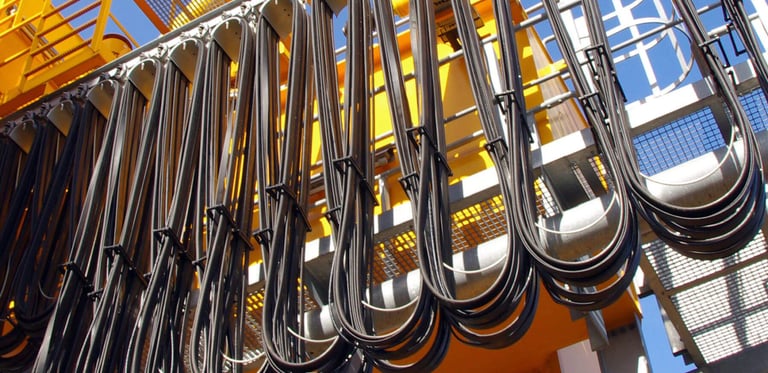
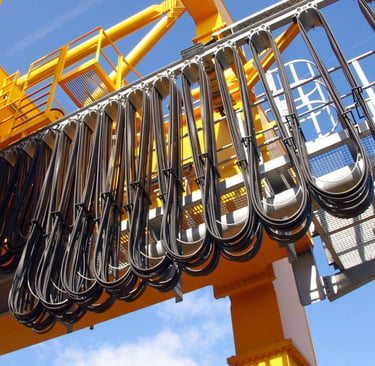
In automated crane systems, intermodal freight hubs, and heavy industrial automation, moving structures rely on continuous signal, control, and power transmission. When an overhead crane or container trolley traverses back and forth hundreds of times a day, the cables riding on festoon tracks or inside energy chains undergo constant planar bending, lateral forces, and acceleration shock.
Historically, round flexible cables were deployed for these moving applications. However, standard round cables suffer from mechanical strain distribution problems when bent repeatedly along a single axis, leading to internal core corkscrewing, premature outer jacket tearing, and asymmetric conductor fatigue. Furthermore, as modern industrial machinery increasingly relies on variable speed drives, high-frequency inverters, switchgear, and complex Programmable Logic Controller networks, unshielded or poorly shielded cables suffer from Electromagnetic Interference. Electromagnetic interference leads to signal distortion, false sensor readings, encoder packet loss, and unscheduled operational downtime.
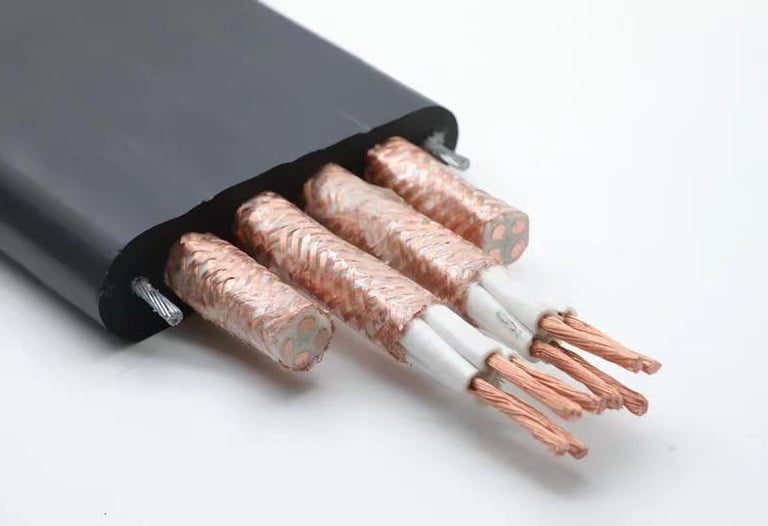
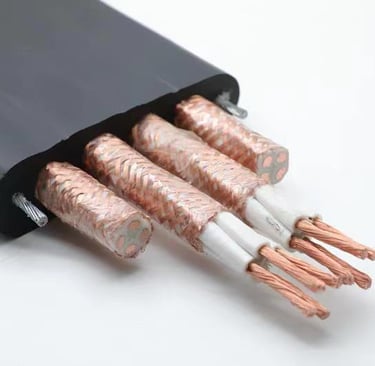
The Feichun M(StD)HÖU Shielded Flat Control Cable is designed specifically to resolve both the mechanical strain and electromagnetic interference issues inherent in heavy dynamic applications. Manufactured according to rigorous standards including UL Style 4540 and principles based on DIN VDE 0250-809, this heavy-duty, rubber-insulated, neoprene-sheathed screened flat cable provides superior signal integrity and long service life in dynamic festoon systems.
This comprehensive engineering guide analyzes the structural design, electrical parameters, electromagnetic shielding principles, and installation advantages of the Feichun M(StD)HÖU cable. It provides electrical engineers, port automation directors, and mine maintenance managers with the technical data necessary to optimize moving cable systems.
1. Introduction: M(StD)HÖU as a Shielded Flat Control Cable
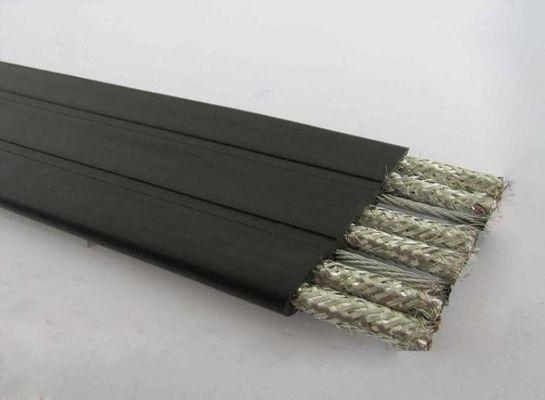
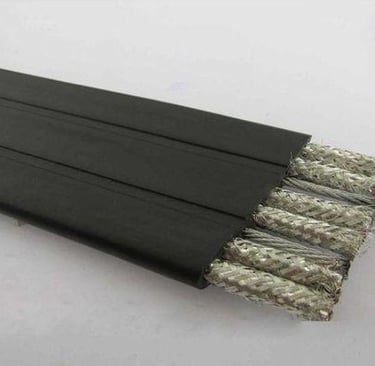
The Feichun M(StD)HÖU cable is a specialized, screened flat power, control, and signal cable engineered for dynamic applications such as festoon systems, trolley feed lines, overhead gantry cranes, container bridges, and automated stacker-reclaimers.
While flat cables are frequently used for primary power feeds, this guide focuses on the engineering application of M(StD)HÖU as a shielded control and data transmission line. In modern automated cranes and industrial cranes, the cable must deliver accurate sensor data, encoder pulses, safety interlock commands, and low-voltage control signals along moving booms and bridges while running parallel to noisy, high-power motor cables.
Operating Conditions and Environmental Resilience
Feichun M(StD)HÖU is constructed to withstand aggressive ambient conditions in both indoor and outdoor industrial settings:
Dry, Damp, and Wet Locations: The cable can be submerged under moisture splash and continuous high humidity environments without suffering deterioration in its insulation resistance.
Extreme Thermal Ranges: It is capable of operating in static conditions from negative forty degrees Celsius up to positive eighty degrees Celsius, and in continuous dynamic flexural operation from negative thirty degrees Celsius up to positive eighty degrees Celsius.
High Mechanical Stress: It is engineered specifically for dynamic flexing constrained to a single bending plane, absorbing longitudinal tensile forces while eliminating internal torsional strain.
Chemical and Environmental Exposure: The outer construction provides high resistance to mineral oils, hydraulic fats, ozone, ultraviolet radiation, and atmospheric chemical pollution commonly found in mining ports and heavy processing plants.
2. Type Designation and Structural Nomenclature
The alphanumeric designation M(StD)HÖU follows established German VDE normative conventions, detailing each functional layer of the cable design. Understanding this nomenclature allows project engineers to select the exact specification required for their operating parameters.
2.1 "M" – Flexible Control and Power Cable for Mobile Applications
In standard cable taxonomy based on DIN VDE specifications, the letter "M" indicates a flexible, heavy-duty cable designed for mobile electrical machinery, hoisting equipment, lift systems, container bridges, and conveyor networks.
Unlike stationary building wire or static tray cables, an "M" designated cable is constructed with fine-stranded bare copper conductors to withstand continuous reverse bending without suffering metal fatigue, work hardening, or strand snapping. Furthermore, when specified as a power and control cable, it allows low-voltage auxiliary power and high-density control circuit conductors to be housed within a unified flat jacket profile.
2.2 "(StD)" – Screening and Electromagnetic Shielding Design
The "(StD)" element highlights the cable's internal shielding architecture. Screening is essential for control cables installed in close proximity to power electronics.
Depending on the core configuration and signal requirement, the (StD) shield features:
Laminated Aluminium or PETP Foil: An overlapping foil layer providing one hundred percent electrostatic coverage against high-frequency capacitive noise.
Tinned Copper Braid or Spinning: A braided or spiraled layer of fine tinned copper wires applied over the foil or core bundle with an optical coverage exceeding eighty-five percent.
Individually Screened Pairs: For multi-pair control variants—such as four-pair or seven-pair configurations—each twisted pair is wrapped in an individual screen to prevent crosstalk between adjacent control loops.
This composite shielding delivers low transfer impedance across a broad frequency spectrum, preventing electromagnetic fields generated by adjacent motor lines or switching contactors from interfering with sensitive control logic.
2.3 "HÖU" – Elastomeric Insulation and Oil-Resistant Outer Sheath
The terminal letter sequence defines the elastomeric compounds engineered for physical endurance:
"H" (Rubber Insulation): Denotes the high-grade elastomeric insulation applied over individual copper conductors. Feichun utilizes an Ethylene Propylene Rubber compound type 3GI3 according to DIN VDE 0207-20. Ethylene Propylene Rubber provides excellent dielectric strength, low dielectric losses, high thermal withstand up to ninety degrees Celsius continuous conductor temperature, and extreme flexibility under low ambient temperatures.
"Ö" (Oil-Resistant Compound): Indicates that the outer protective sheath is compounded to resist oils, hydraulic fluids, and greases. Feichun uses a heavy-duty Polychloroprene synthetic rubber compound type 5GM3 according to DIN VDE 0207-21.
"U" (Flame-Retardant and Mobile Specification): Designates that the cable is flame-retardant (passing UL FT-1 flame tests) and designed for continuous dynamic operation in mobile festoon systems and mechanical handling gear.
3. Cable Construction and Electromagnetic Protection
To appreciate why the Feichun M(StD)HÖU cable outperforms conventional round cables on crane festoons, one must evaluate its internal physical geometry and mechanical layering. The build process follows a strict sequence of high-precision manufacturing steps:
First, stranded copper conductors made of Class 5 or Class 6 extremely fine strands are formed. Second, a separator layer consisting of paper tape or PETP film wrapping is applied. Third, high-grade 3GI3 Ethylene Propylene Rubber insulation is extruded over the conductors. Fourth, core identification is established via color coding or sequential white numbering on black insulation. Fifth, the cores are laid up in parallel or arranged as short-lay twisted pairs. Sixth, the electromagnetic shield, consisting of an aluminium/PETP foil paired with a tinned copper braid exceeding eighty-five percent coverage, is applied. Seventh, a protective wrapping of PETP film serves as a sheath separator. Finally, the outer sheath of heavy-duty black polychloroprene rubber compound 5GM3 is extruded to complete the assembly.
3.1 Conductor Fine-Stranding and Insulation
Feichun M(StD)HÖU conductors are manufactured using highly pure, electrolytic bare copper wire:
Conductor Cross-Sections up to 25 mm²: Constructed using Class 6 extra-fine stranding according to IEC 60228 and DIN EN 60228. Class 6 stranding utilizes microscopic wire filaments twisted into bunched conductors, offering maximum mechanical flexibility and high tolerance against repetitive flexing fatigue.
Conductor Cross-Sections 35 mm² and above: Constructed using Class 5 fine stranding, striking an optimal balance between high current carrying capacity, mechanical stiffness control, and flex life.
Separator Tape: A paper tape or PETP film is wrapped over the bare copper core prior to insulation extruding. This prevents the rubber insulation from adhering directly to the copper, allowing the strands to slide freely during dynamic bending and reducing internal material wear.
EPR Rubber Insulation: High-grade 3GI3 Ethylene Propylene Rubber insulation is extruded smoothly over each conductor.
Core identification complies with standard industrial conventions:
Up to 5 Cores (-J or -O Variants): Color-coded according to DIN VDE 0293-308, including a green/yellow earth core in -J versions.
6 Cores and Above: Black insulation printed with distinct, high-contrast white numbers running sequentially along the core length.
3.2 Advanced Shielding Construction
The efficiency of an EMC cable shielding system depends heavily on its physical structure. The Feichun M(StD)HÖU utilizes a multi-stage composite shielding design:
Inner PETP Tape Wrap: The parallel-laid insulated cores or twisted pairs are enclosed within a polyester film tape.
Aluminium-Polymer Foil Screen: A continuous, overlapping Aluminium/PETP tape is wrapped around the core bundle. The metallic side of the foil provides a continuous conductive electrostatic barrier that blocks high-frequency capacitive field interference.
Tinned Copper Braid Spinning: Over the foil barrier, a dense braid or spiral spinning of tinned copper wires is applied. Tinning the copper strands prevents atmospheric corrosion and oxidation, ensuring stable electrical contact and low surface transfer impedance throughout the cable's operational life.
Shield Coverage: The optical coverage density of the tinned copper braid is strictly controlled to be equal to or greater than eighty-five percent. In custom bus or data variants, pair-shield coverage reaches approximately eighty to eighty-five percent, providing high protection against electromagnetic field coupling.
Outer Protective Separation: A final layer of PETP film wraps the shield assembly, isolating it from the outer polychloroprene jacket to prevent mechanical abrasion during jacket extrusion and continuous dynamic flexing.
3.3 Electromagnetic Interference Protection in Dynamic Drive Environments
Industrial overhead cranes and bulk handling machinery feature intense electromagnetic activity. Variable Frequency Drives switching at frequencies between two kilohertz and sixteen kilohertz generate sharp voltage rise rates, resulting in severe radiated and conducted high-frequency electrical noise across the system.
When unshielded control or signal lines run parallel to power cables along a festoon track, electromagnetic fields induce unwanted noise voltages in the control wires. This can result in PLC digital input false-triggering, analog sensor drift, incremental encoder pulse dropouts causing positioning errors in automated stacker cranes, and communication loss across fieldbus networks such as Profibus, CANbus, or Industrial Ethernet.
The Feichun M(StD)HÖU shield acts as a Faraday cage surrounding the inner control cores. Conducted and radiated noise currents hitting the outer shield are captured and safely routed to ground via earth bonding terminals. The low transfer impedance optimized around thirty megahertz ensures clean signal transmission, protecting both low-voltage sensor lines and high-speed control feedback loops.
3.4 Outer Jacket Compound and Mechanical Resistance
The outer sheath of the Feichun M(StD)HÖU cable is built using a heavy-duty Polychloroprene rubber compound (Type 5GM3 according to DIN VDE 0207-21).
Polychloroprene offers a well-balanced combination of mechanical and chemical properties:
High Tensile Strength and Tear Resistance: Resists mechanical tearing caused by cable saddles, festoon trolley clamps, and external abrasives.
Chemical Immunity: Impermeable to splash oils, diesel fuel, lubricating fats, and alkaline cleaning fluids commonly used in port maintenance workshops.
Weathering and Ozone Resistance: Highly resistant to UV radiation and ozone breakdown, preventing surface micro-cracking during long-term exposure in sun-drenched Australian environments.
Flame Retardancy: Self-extinguishing material compliant with UL Style 4540 and FT-1 vertical flame resistance standards.
4. Electrical and Signal Performance Characteristics
Evaluating electrical parameters ensures that the control cable selected will integrate safely into the machine's electrical power system while meeting sensor impedance requirements.
Key performance specifications for the Feichun M(StD)HÖU cable include a rated voltage (U0/U) of 0.6/1 kV (600/1000 V). The maximum permissible AC operating voltage reaches 0.7/1.2 kV, while the maximum permissible DC operating voltage is 0.9/1.8 kV. The cable withstands an AC test voltage of 2.5 kV applied over 5 minutes. Thermally, it supports a maximum continuous conductor operating temperature of 90 degrees Celsius and a short-circuit limit temperature of 250 degrees Celsius for up to 5 seconds. Mechanically, the tensile load limit is rated at 15 N/mm² of total copper cross-sectional area.
4.1 Voltage Ratings and Circuit Segregation
The Feichun M(StD)HÖU control cable carries an industrial insulation voltage rating of 0.6/1 kV (600/1000 V). This high dielectric withstand capability offers critical operating advantages:
Mixed Voltage Integration: Allows high-voltage control lines (such as 230 V AC brake controls and 110 V AC contactor coils) and low-voltage DC signals (such as 24 V DC safety interlocks and 4 to 20 mA sensor loops) to be safely routed within the same multi-core flat cable without dielectric breakdown risks.
Voltage Surge Protection: The 2.5 kV AC test voltage rating provides a high insulation margin against transient voltage spikes and inductive kickback generated when large magnetic contactors or mechanical brakes disconnect.
4.2 Low Capacitance and Impedance-Controlled Signal Behaviour
In dynamic control systems, long cable runs along crane bridges (often exceeding 50 to 100 meters) can act as distributed capacitors. High core-to-core capacitance causes pulse rounding on digital signals, high-frequency signal attenuation, and unwanted capacitive leakage currents.
Feichun M(StD)HÖU flat cables feature low dielectric constant Ethylene Propylene Rubber insulation combined with uniform core geometry. This layout maintains stable, low core-to-core capacitance values.
For dedicated data transmission, encoder feedback, and bus communication, special variants such as Feichun M(StD)HÖU-O 4x(2x1) or 6x(2x2,5)C feature twisted pair constructions with individual pair shielding. Twisting two control wires together with a short lay length cancels magnetic field loops, while individual pair shielding prevents crosstalk between adjacent pairs.
5. Architectural Advantages of Shielded Flat Cable Engineering
Selecting a flat cable format over a conventional round cable geometry provides distinct mechanical and space-saving benefits for dynamic machinery.
5.1 Planar Bending Mechanics and Reduced Stress
A round cable contains cores twisted spirally around a central axis. When a round cable is forced to flex rapidly over a festoon pulley or drum, the cores located on the outer radius of the bend experience extreme tension, while cores on the inner radius experience severe compression. Over thousands of operational cycles, this asymmetric stress forces internal cores to migrate, resulting in cable deformation known as corkscrewing, followed by conductor breakage.
In contrast, a flat cable layout positions all insulated cores side-by-side along a single horizontal axis. When the cable flexes, every conductor bends along the same axis:
Tensile stress is distributed evenly across the entire width of the cable.
Internal core shear forces and core-to-core friction are virtually eliminated.
Torsional stress on individual wire strands is avoided, preventing strand failure.
5.2 Space-Saving and Guided Installation Advantages
In modern container cranes and industrial overhead gantries, space on trolley support beams is limited.
Compact Festoon Stacks: Flat cables can be stacked neatly on top of one another inside festoon trolley saddles. A stack of flat cables requires significantly less vertical height than an equivalent bundle of round cables.
Controlled Loop Formation: The flat profile restricts cable motion to a single plane. When a festoon trolley decelerates rapidly, flat cables flex predictably in uniform loops without twisting sideways or catching on structural steelwork.
Tighter Bending Radii: Because the thickness of a flat cable is substantially smaller than its overall width, its minimum bending radius along the motion axis is much smaller than that of a round cable of equivalent cross-sectional capacity. This allows festoon systems to utilize smaller pulleys and compact trolley frames, lowering overall capital equipment costs.
6. Applications in Heavy Industry and Crane Automation
The mechanical durability and high EMC rating of Feichun M(StD)HÖU make it ideal for demanding industrial applications across Australia:
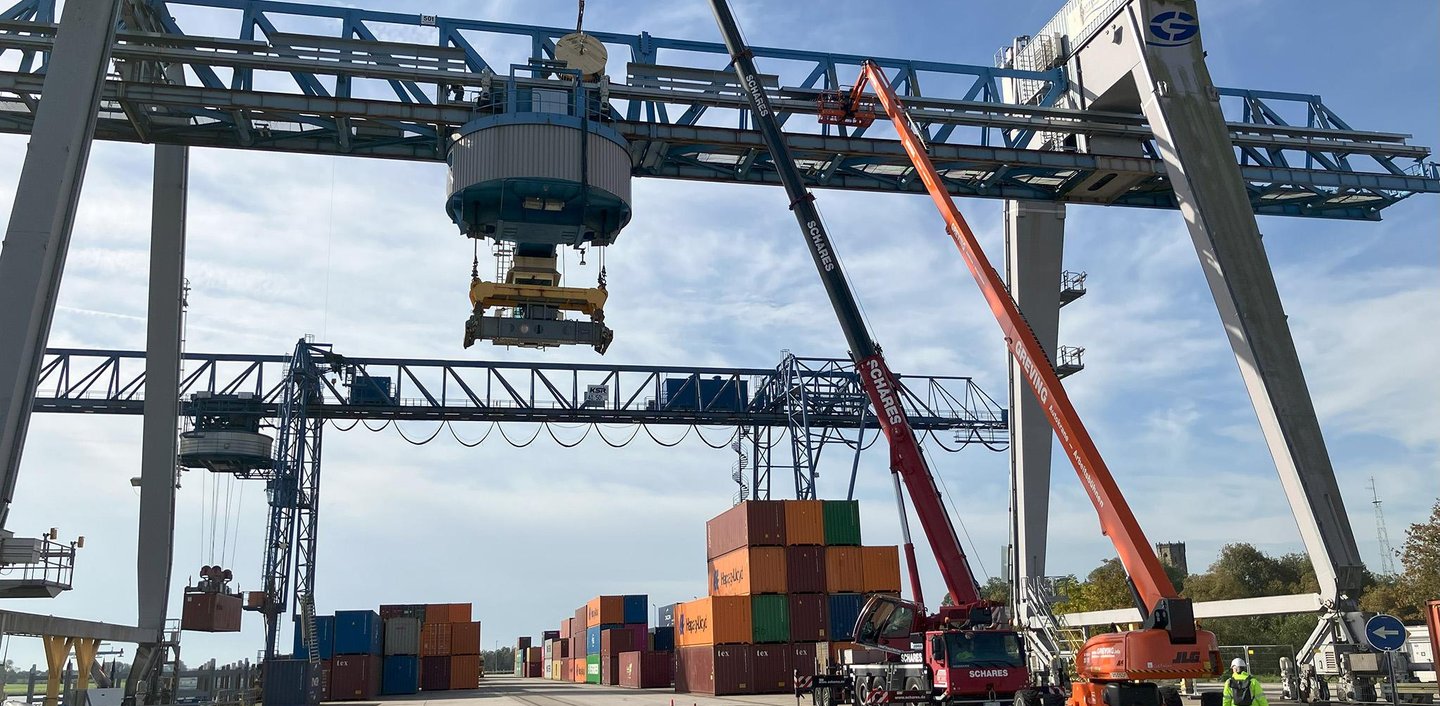
Port & Marine Terminals: Deployed on Ship-to-Shore cranes, Rail-Mounted Gantry cranes, Rubber-Tyred Gantry container trolleys, and bulk ship loaders.
Mining & Materials Handling: Integrated into stacker-reclaimers, iron ore conveyor trippers, and dragline auxiliary systems.
Heavy Manufacturing: Ideal for overhead traveling cranes, steel mill ladle cranes, and gantry hoists.
Advanced Industrial Automation: Utilized in linear transfer machines, Automated Storage and Retrieval Systems (ASRS), and robot gantry tracks.
6.1 Container Ports and Marine Terminals
At major Australian port facilities—such as Botany Bay in New South Wales, the Port of Melbourne in Victoria, and the Port of Brisbane in Queensland—Ship-to-Shore cranes, Rail-Mounted Gantry cranes, and Rubber-Tyred Gantry cranes operate continuously.
These cranes utilize high-speed festoon trolleys moving at travel speeds up to 180 m/min. The trolley cables are exposed to salt spray, direct UV sunlight, and high wind loads while continuously transmitting critical commands: trolley travel drive control logic, main hoist encoder positioning feedback, anti-sway laser sensor data lines, and emergency stop circuit signals.
The Feichun M(StD)HÖU screened control cable protects signal pathways from EMI emitted by nearby 600 kW main hoist drives. Its polychloroprene sheath prevents salt-water ingress and UV degradation, delivering reliable operation across millions of container moves.
6.2 Bulk Mining Operations and Processing Plants
In the Pilbara region of Western Australia and the Bowen Basin in Queensland, iron ore and coal handling facilities utilize massive automated stacker-reclaimers and rail car dumpers.
Feichun M(StD)HÖU cables are widely installed on boom festoons and travelling tripper cars on these systems:
Load Cell Sensing: Transmitting minute analog voltage signals from hopper weigh-scales to PLC control rooms without noise interference.
Position Monitoring: Relay signals from proximity sensors, ultrasonic tilt switches, and optical limit switches.
Heavy Thermal Durability: Operating reliably under direct sunlight in ambient mine site temperatures exceeding positive forty-five degrees Celsius (with continuous conductor ratings up to positive ninety degrees Celsius).
6.3 Overhead Traveling Cranes and Factory Automation
In heavy manufacturing environments—such as steel mills, aluminium smelters, and automated manufacturing plants—overhead traveling cranes operate under harsh conditions with elevated ambient heat, ambient oil mist, and dust.
Feichun M(StD)HÖU delivers high reliability in these settings:
Pendant Controls and Remote Receiver Units: Connecting moving crane hoists to radio control interface boxes and cabin displays.
Machine Tooling and Linear Transfer Automation: Providing low-profile control wiring along linear slide tracks and automated storage carriages where tight bending radii and oil resistance are mandatory.
7. Practical Engineering Selection and Installation Guidelines
Selecting the proper Feichun M(StD)HÖU cable specification requires a thorough evaluation across three core engineering checks: electrical check, EMC and shield check, and mechanical check.
7.1 Key Technical Selection Parameters
1. Voltage Rating and Conductor Sizing
Confirm that operating voltages do not exceed 0.6/1 kV AC. Size control conductors based on continuous current carrying capacity (derated for ambient temperatures exceeding thirty degrees Celsius) and total loop length voltage drop. Standard control sizes include 1.5 mm² and 2.5 mm², available in 4-core, 5-core, 8-core, 12-core, and up to 24-core variants.
2. EMC Screening Requirement
For general control loops, limit switch logic, and 230 V contactor wiring, select the overall screened Feichun M(StD)HÖU-J series featuring an overall aluminium foil and tinned copper braid with greater than eighty-five percent coverage.
For sensitive analog signals, encoder pulses, or fieldbus networks running parallel to power lines, select the individually screened pair variant Feichun M(StD)HÖU-O (such as 4x(2x1) or 12x(2x1)), which prevents internal crosstalk between signal loops.
3. Mechanical Parameters and Travel Speed
The cable is rated for festoon system travel speeds up to 180 m/min. For applications exceeding 180 m/min, consult Feichun application engineers for system design approval.
Ensure maximum dynamic tension on copper conductors does not exceed 15 N/mm² of total copper cross-section. External strain relief towing ropes or steel support cables must be installed if festoon acceleration forces exceed this threshold.
Torsional stress is strictly not allowed. Cables must be installed completely parallel without axial twists.
8. Installation Best Practices for Festoon Systems
To maximize the operating life of Feichun M(StD)HÖU flat cables in dynamic festoon applications, installers must follow these core engineering practices:
Unreel Cable Correctly: When removing cable from the supply drum, always roll the drum along the ground or mount it on an axle spindle to pull the cable off linearly. Never pull cable off the side flange of a stationary reel, as this introduces permanent spiral twists into the flat structure, leading to premature cable failure when installed on a festoon system.
Observe Bending Radius: Maintain minimum dynamic bending radius according to VDE 0298 Part 3 specifications.
Proper Saddle Clamping: Festoon trolley clamps must feature rounded clamping edges equipped with smooth rubber lining. Clamps must be tightened sufficiently to prevent cable slippage during rapid acceleration, but must not be overtightened to the point of compressing or distorting the outer polychloroprene jacket.
Parallel Cable Stacking: When stacking multiple flat cables in a single saddle, place cables with larger cross-sections at the bottom of the saddle stack and lighter control cables on top. Ensure all cables flex freely in a uniform loop pattern without binding against adjacent lines.
360-Degree Shield Grounding: Terminate the tinned copper braid screen at both ends using metallic EMC cable glands featuring a 360-degree ground bonding ring. Connect the screen directly to the low-impedance copper earth busbar inside the electrical enclosure. Avoid stripping the shield braid into a long twisted wire strand, as this introduces high inductive impedance at high frequencies, degrading EMC performance.
Conclusion: Maximizing Uptime with Feichun Cable Engineering
In heavy industrial operations, port facilities, and automated processing plants, operational downtime caused by control cable failure is costly. Unshielded or mechanically unsuitable cables deployed on high-speed festoons inevitably suffer from electromagnetic interference, signal loss, and mechanical fatigue.
The Feichun M(StD)HÖU Shielded Flat Control Cable delivers an engineered solution designed specifically for dynamic, high-stress applications. Combining Class 5 and Class 6 fine-stranded copper conductors, high-thermal Ethylene Propylene Rubber insulation, an overall tinned copper braid shield offering greater than eighty-five percent coverage, and a robust oil- and UV-resistant polychloroprene outer jacket, Feichun M(StD)HÖU ensures dependable signal integrity and long operational life.
By implementing Feichun M(StD)HÖU control cables on overhead cranes, container gantries, and automated materials handling systems, plant operators and systems integrators achieve total signal protection by eliminating drive noise across control loops, extended mechanical flex life through uniform planar stress distribution, and comprehensive environmental resilience against oil, water, UV exposure, and thermal extremes.
How to Reach Us
Get in Touch
SiteMap
Product Catalogue
Festoon Cable
Shore Power Cable



Scan to add us on WeChat