Heavy-Duty Dynamic Reeling Performance: Engineering Guide to TROMMELFLEX PUR-HF D12Y11YU11Y Cables for Cranes, Ports, and Material Handling
Learn about the D12Y11YU11Y cable, a heavy-duty PUR reeling power cable for cranes, ports, and material handling equipment under high mechanical stress and frequent movement.
hongjing.Wang@Feichun
7/24/202612 min read
Introduction
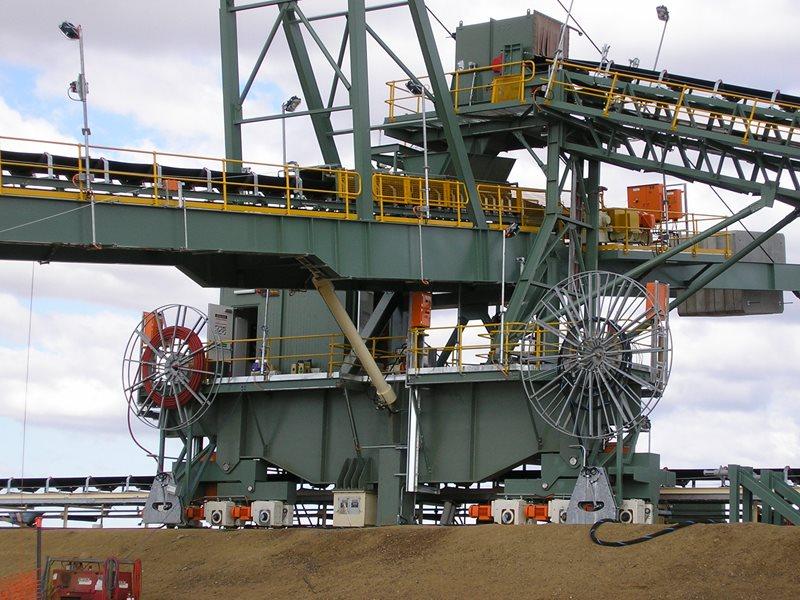
In modern bulk material handling, maritime port operations, and industrial lifting equipment, electrical distribution cables face severe physical demands. Cables powering mobile gantry cranes, automated container stackers, dynamic ship loaders, and high-speed conveyor systems must withstand high tensile pulling forces, continuous reversing motion, severe outdoor exposure, and tight bending around reels and guide pulleys. Standard fixed wiring or light-duty flexible cables quickly fail under these harsh mechanical conditions, leading to unexpected equipment downtime, safety hazards, and costly repairs.
To solve these operational challenges, site engineers turn to specialized low-voltage reeling cables engineered specifically for severe dynamic service. The TROMMELFLEX PUR-HF D12Y11YU11Y cable represents a top-tier solution in this category. Built with a dual-sheath Polyurethane (PUR) construction, halogen-free polyester insulation, and embedded anti-torsion braiding reinforcement, this cable delivers high mechanical strength, chemical immunity, and long flex life under continuous winding and unwinding operations.
Whether deployed on Rubber-Tyred Gantry (RTG) cranes in busy container terminals, long-travel stacker-reclaimers across bulk export yards, or dynamic festoons in heavy industrial facilities, high-performance cables—such as those produced by Feichun—are designed to meet rigorous global standards while enduring tough environmental conditions.
This comprehensive technical guide explores the structural architecture, electrical parameters, environmental ratings, and practical applications of the D12Y11YU11Y cable series.
What D12Y11YU11Y Cable Is
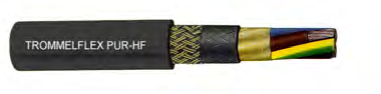
The TROMMELFLEX PUR-HF D12Y11YU11Y-J/O is a flexible, halogen-free, low-voltage reeling cable engineered for equipment operating under intense mechanical stress and high continuous motion.
To understand its technical characteristics, it helps to decode the VDE-aligned D12Y11YU11Y designation:
D: Identifies a heavy-duty flexible dynamic cable built according to VDE standard principles.
12Y: Refers to the halogen-free polyester-based core insulation.
11Y (First Instance): Denotes the tough, halogen-free polyurethane (PUR) inner sheath.
U: Highlights the embedded anti-torsion open braiding textile reinforcement layer.
11Y (Second Instance): Denotes the protective polyurethane (PUR) outer jacket.
-J / -O Suffixes: -J specifies the inclusion of a green/yellow protective earth conductor, whereas -O indicates an ungrounded multi-core construction.
Unlike traditional PVC or heavy rubber-sheathed cables, the D12Y11YU11Y construction balances low structural weight with high mechanical strength. It is purpose-built for motor-driven cable reels, spring reels, festoon loops, and energy chains operating at high speeds.
Standard References
The manufacturing, testing, and safety parameters of the TROMMELFLEX PUR-HF D12Y11YU11Y cable comply with international electrical and material standards:
DIN VDE 0250: Provides the design principles and structural designation framework for dynamic reeling cables.
DIN EN 60228 / IEC 60228 (Class 5): Governs conductor construction, specifying fine-stranded copper for high flexibility.
DIN VDE 0293-308: Dictates standard color coding for core identification in low-voltage power and control circuits.
DIN VDE 0298-4: Establishes current-carrying capacities, grouping factors, and thermal derating requirements for flexible industrial cables.
IEC 60332-1: Defines flame-retardant performance tests for single insulated vertical wires or cables.
IEC 60811 Series: Defines material testing protocols for evaluating oil resistance, tear growth, tensile strength, and sheath durability.
Cable Construction Features
The D12Y11YU11Y cable relies on a layered composite design engineered to manage physical stress, twisting, and harsh environmental exposure.
Conductor
At the center of each core are fine-stranded plain copper wires built to Class 5 flexibility standards under DIN EN 60228 / DIN VDE 0295.
Fine stranding allows individual copper wires to slide smoothly past one another during tight bending, reducing internal strain.
Highly flexible conductors prevent metal fatigue, strand snapping, and internal resistance spikes during continuous spooling.
Core Insulation
Conductors are enclosed in a specialized halogen-free compound based on polyester.
Supports dynamic flexing while maintaining a thin insulation wall profile.
Provides high thermal resistance up to +90°C continuous conductor operating temperature.
Eliminates halogens, ensuring low toxic smoke release in fire situations.
Core Identification and Core Lay-Up
Core identification follows standardized conventions for simple field installation:
Up to 5 cores: Color-coded according to DIN VDE 0293-308.
6 or more cores: Natural white insulation with clear black numbers printed sequentially, accompanied by a green/yellow earth conductor in -J variants.
The insulated cores are twisted around a central textile carrier unit using a extra-short length of lay. This central strain-relief core absorbs axial pulling tension and prevents core bundle collapse during continuous spooling cycles.
Inner Sheath and Reinforcement Layer
Over the twisted cores sits an inner sheath made from halogen-free, flame-retardant polyurethane (PUR).
Directly over this inner sheath is an open braiding of support—a synthetic textile anti-torsion mesh embedded between the inner and outer sheaths.
Locks the inner and outer PUR sheaths into a unified structural unit.
Neutralizes rotational torque generated when reeling under tension, preventing jacket buckling and internal "corkscrewing".
Increases allowable conductor tensile load capacity up to 25 N/mm².
Outer Sheath
The cable is finished with a tough, opaque black Polyurethane (PUR) outer sheath that is halogen-free and flame-retardant.
Polyurethane provides significant mechanical advantages over standard rubber or PVC sheaths:
High Abrasion Resistance: Withstands continuous scraping over steel flanges, guide sheaves, and rough ground.
Cut and Tear Growth Resistance: Prevents minor surface cuts from splitting open during severe bending.
Chemical and Oil Resistance: Immune to degradation from industrial grease, mineral oils, hydraulic fluids, and chemical splashes.
Weathering and UV Resistance: Resists sun-cracking and ozone degradation during continuous outdoor service.
Electrical Specifications
The TROMMELFLEX PUR-HF D12Y11YU11Y series delivers reliable power and control performance across low-voltage equipment:
Nominal Rated Operating Voltage (Uo/U): 0.6 / 1 kV (600 / 1000 Volts AC).
Maximum Permissible AC Operating Voltage: 0.7 / 1.2 kV AC.
Maximum Permissible DC Operating Voltage: 0.9 / 1.8 kV DC.
AC High-Voltage Test: Factory tested at 4 kV AC for 5 minutes to verify insulation soundness.
Current Carrying Capacity: Rated per DIN VDE 0298-4 standards, taking into account multi-layer reel thermal derating factors.
Thermal and Environmental Performance
Equipped with advanced polymer layers, the D12Y11YU11Y cable operates reliably across wide temperature swings and wet site conditions:
Maximum Permissible Conductor Operating Temperature: +90°C.
Maximum Short-Circuit Temperature: Up to +250°C (for durations up to 5 seconds).
Ambient Temperature Range (Fixed Installation): -50°C to +80°C.
Ambient Temperature Range (Fully Flexible Reeling Operation): -40°C to +80°C.
Flame Resistance Rating: Tested to IEC 60332-1 flame-retardant standards.
Submersion and Water Resistance: Rated for continuous underwater submersion up to 50 meters diving depth (non-potable water), making it ideal for flooded cable pits, wet docks, and coastal sumps.
Dynamic Mechanical Ratings
The D12Y11YU11Y cable is engineered specifically for dynamic motion under high physical loads:
Maximum Tensile Load on Conductors: Up to 25 N/mm² total copper cross-sectional area during operation.
Permissible Torsional Stress: Up to ±50° per meter, allowing the cable to absorb twisting caused by uneven spooling or roller alignment.
Minimum Dynamic Bending Radius: 6 times the overall cable diameter (6 x D), verified by continuous flexing tests per HD 22.2 Part 3.1.
Reeling Travel Speed: Unlimited under normal operational conditions (for speeds exceeding 180 m/min, consult technical specialists).
Festoon Travel Speed: Up to 180 meters per minute.
Cable Dimension and Specification Profiles
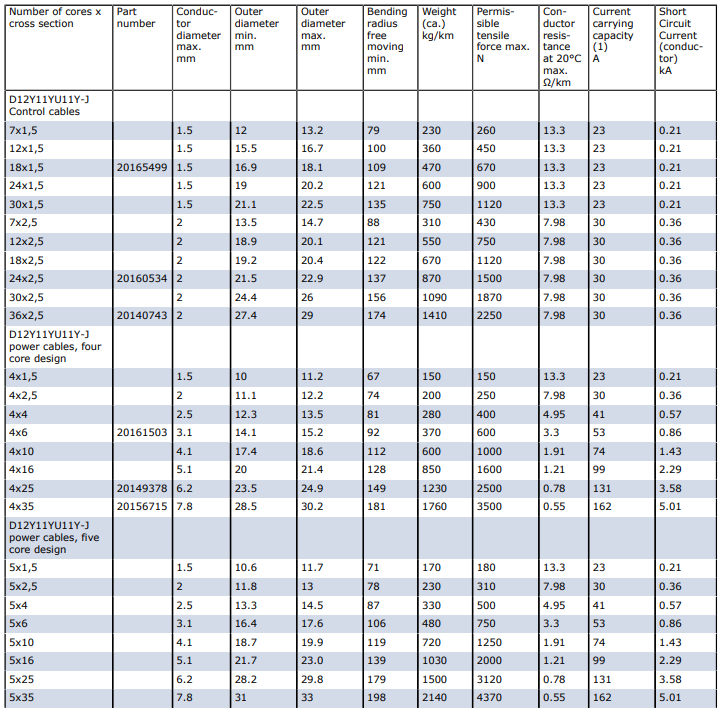
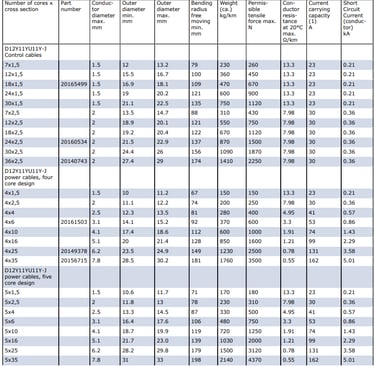
The D12Y11YU11Y series is produced in multi-core control and heavy power configurations. The dimensional details below highlight cross-sections, weight profiles, current ratings, and short-circuit limits across standard sizes:
Dynamic Control Cables (D12Y11YU11Y-J Multi-Core)
7 x 1.5 mm²: Outer diameter 12.0–13.2 mm, min bend radius 79 mm, weight 230 kg/km, max tensile load 260 N, max conductor resistance 13.3 Ω/km, current rating 23 A, short-circuit current 0.21 kA.
12 x 1.5 mm²: Outer diameter 15.5–16.7 mm, min bend radius 100 mm, weight 360 kg/km, max tensile load 450 N, max conductor resistance 13.3 Ω/km, current rating 23 A, short-circuit current 0.21 kA.
18 x 1.5 mm²: Outer diameter 16.9–18.1 mm, min bend radius 109 mm, weight 470 kg/km, max tensile load 670 N, max conductor resistance 13.3 Ω/km, current rating 23 A, short-circuit current 0.21 kA.
24 x 1.5 mm²: Outer diameter 19.0–20.2 mm, min bend radius 121 mm, weight 600 kg/km, max tensile load 900 N, max conductor resistance 13.3 Ω/km, current rating 23 A, short-circuit current 0.21 kA.
30 x 1.5 mm²: Outer diameter 21.1–22.5 mm, min bend radius 135 mm, weight 750 kg/km, max tensile load 1120 N, max conductor resistance 13.3 Ω/km, current rating 23 A, short-circuit current 0.21 kA.
7 x 2.5 mm²: Outer diameter 13.5–14.7 mm, min bend radius 88 mm, weight 310 kg/km, max tensile load 430 N, max conductor resistance 7.98 Ω/km, current rating 30 A, short-circuit current 0.36 kA.
12 x 2.5 mm²: Outer diameter 18.9–20.1 mm, min bend radius 121 mm, weight 550 kg/km, max tensile load 750 N, max conductor resistance 7.98 Ω/km, current rating 30 A, short-circuit current 0.36 kA.
18 x 2.5 mm²: Outer diameter 19.2–20.4 mm, min bend radius 122 mm, weight 670 kg/km, max tensile load 1120 N, max conductor resistance 7.98 Ω/km, current rating 30 A, short-circuit current 0.36 kA.
24 x 2.5 mm²: Outer diameter 21.5–22.9 mm, min bend radius 137 mm, weight 870 kg/km, max tensile load 1500 N, max conductor resistance 7.98 Ω/km, current rating 30 A, short-circuit current 0.36 kA.
30 x 2.5 mm²: Outer diameter 24.4–26.0 mm, min bend radius 156 mm, weight 1090 kg/km, max tensile load 1870 N, max conductor resistance 7.98 Ω/km, current rating 30 A, short-circuit current 0.36 kA.
36 x 2.5 mm²: Outer diameter 27.4–29.0 mm, min bend radius 174 mm, weight 1410 kg/km, max tensile load 2250 N, max conductor resistance 7.98 Ω/km, current rating 30 A, short-circuit current 0.36 kA.
Four-Core Power Cables (D12Y11YU11Y-J)
4 x 1.5 mm²: Outer diameter 10.0–11.2 mm, min bend radius 67 mm, weight 150 kg/km, max tensile load 150 N, max conductor resistance 13.3 Ω/km, current rating 23 A, short-circuit current 0.21 kA.
4 x 2.5 mm²: Outer diameter 11.1–12.2 mm, min bend radius 74 mm, weight 200 kg/km, max tensile load 250 N, max conductor resistance 7.98 Ω/km, current rating 30 A, short-circuit current 0.36 kA.
4 x 4.0 mm²: Outer diameter 12.3–13.5 mm, min bend radius 81 mm, weight 280 kg/km, max tensile load 400 N, max conductor resistance 4.95 Ω/km, current rating 41 A, short-circuit current 0.57 kA.
4 x 6.0 mm²: Outer diameter 14.1–15.2 mm, min bend radius 92 mm, weight 370 kg/km, max tensile load 600 N, max conductor resistance 3.30 Ω/km, current rating 53 A, short-circuit current 0.86 kA.
4 x 10 mm²: Outer diameter 17.4–18.6 mm, min bend radius 112 mm, weight 600 kg/km, max tensile load 1000 N, max conductor resistance 1.91 Ω/km, current rating 74 A, short-circuit current 1.43 kA.
4 x 16 mm²: Outer diameter 20.0–21.4 mm, min bend radius 128 mm, weight 850 kg/km, max tensile load 1600 N, max conductor resistance 1.21 Ω/km, current rating 99 A, short-circuit current 2.29 kA.
4 x 25 mm²: Outer diameter 23.5–24.9 mm, min bend radius 149 mm, weight 1230 kg/km, max tensile load 2500 N, max conductor resistance 0.78 Ω/km, current rating 131 A, short-circuit current 3.58 kA.
4 x 35 mm²: Outer diameter 28.5–30.2 mm, min bend radius 181 mm, weight 1760 kg/km, max tensile load 3500 N, max conductor resistance 0.55 Ω/km, current rating 162 A, short-circuit current 5.01 kA.
Five-Core Power Cables (D12Y11YU11Y-J)
5 x 1.5 mm²: Outer diameter 10.6–11.7 mm, min bend radius 71 mm, weight 170 kg/km, max tensile load 180 N, max conductor resistance 13.3 Ω/km, current rating 23 A, short-circuit current 0.21 kA.
5 x 2.5 mm²: Outer diameter 11.8–13.0 mm, min bend radius 78 mm, weight 230 kg/km, max tensile load 310 N, max conductor resistance 7.98 Ω/km, current rating 30 A, short-circuit current 0.36 kA.
5 x 4.0 mm²: Outer diameter 13.3–14.5 mm, min bend radius 87 mm, weight 330 kg/km, max tensile load 500 N, max conductor resistance 4.95 Ω/km, current rating 41 A, short-circuit current 0.57 kA.
5 x 6.0 mm²: Outer diameter 16.4–17.6 mm, min bend radius 106 mm, weight 480 kg/km, max tensile load 750 N, max conductor resistance 3.30 Ω/km, current rating 53 A, short-circuit current 0.86 kA.
5 x 10 mm²: Outer diameter 18.7–19.9 mm, min bend radius 119 mm, weight 720 kg/km, max tensile load 1250 N, max conductor resistance 1.91 Ω/km, current rating 74 A, short-circuit current 1.43 kA.
5 x 16 mm²: Outer diameter 21.7–23.0 mm, min bend radius 139 mm, weight 1030 kg/km, max tensile load 2000 N, max conductor resistance 1.21 Ω/km, current rating 99 A, short-circuit current 2.29 kA.
5 x 25 mm²: Outer diameter 28.2–29.8 mm, min bend radius 179 mm, weight 1500 kg/km, max tensile load 3120 N, max conductor resistance 0.78 Ω/km, current rating 131 A, short-circuit current 3.58 kA.
5 x 35 mm²: Outer diameter 31.0–33.0 mm, min bend radius 198 mm, weight 2140 kg/km, max tensile load 4370 N, max conductor resistance 0.55 Ω/km, current rating 162 A, short-circuit current 5.01 kA.
Practical Application Scenarios Across Key Industries
The combination of low weight, high tensile load capacity, and Polyurethane protection makes D12Y11YU11Y cabling an ideal choice across demanding industrial sectors:
1. Crane Systems and Lifting Equipment
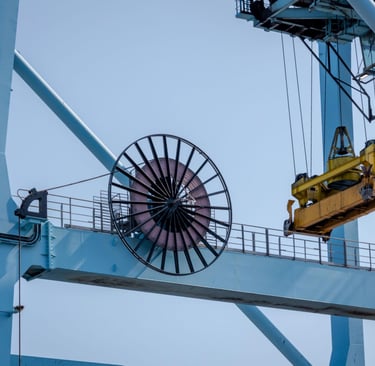
Cranes require power cabling that can withstand constant acceleration, sudden braking, and high-speed spooling.
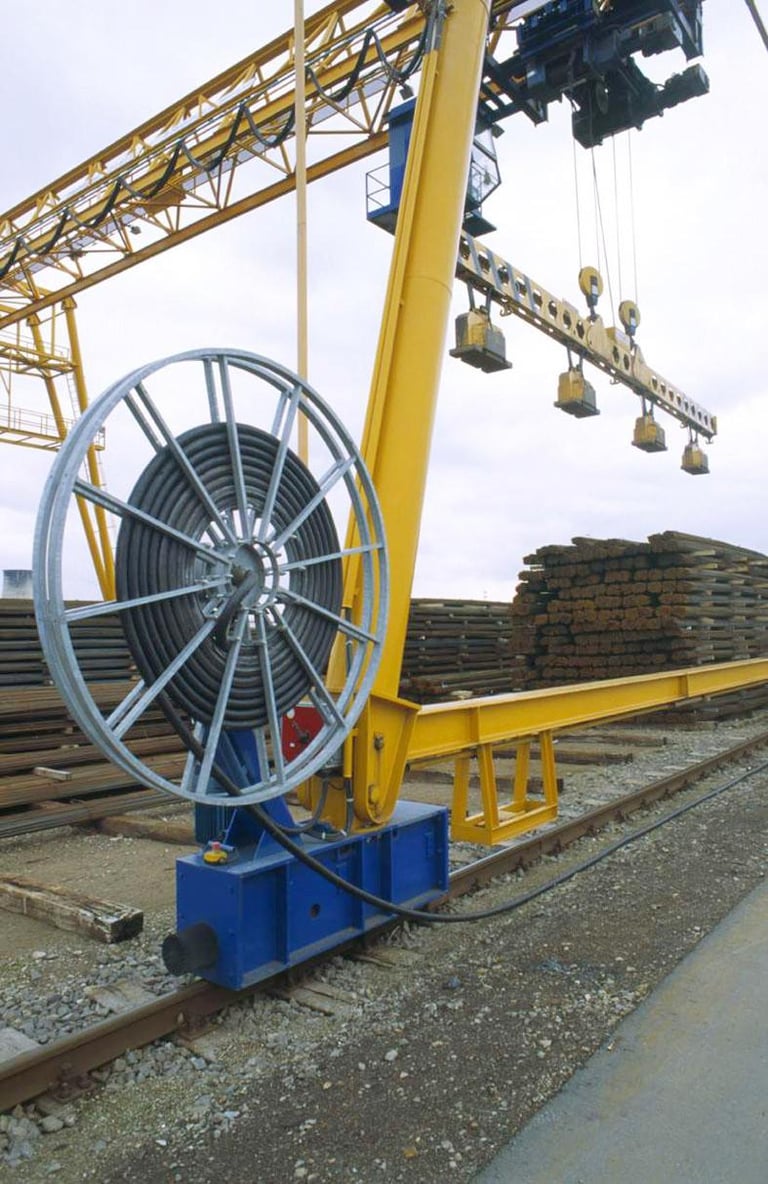
Gantry Cranes: Powers main crane travel drives and trolley assemblies via motorized reels.
Harbor Cranes: Resists ocean winds, salt spray, and continuous lifting cycles in coastal environments.
Ship Loaders: Delivers reliable power over long travel distances on dynamic spooling reels.
2. Maritime Port Terminals
Container ports operate around the clock, relying on automated machinery to move heavy freight.
Rubber-Tyred Gantry (RTG) and Rail-Mounted Gantry (RMG) Cranes: Handles continuous spooling at travel speeds up to 180 m/min across container stacks.
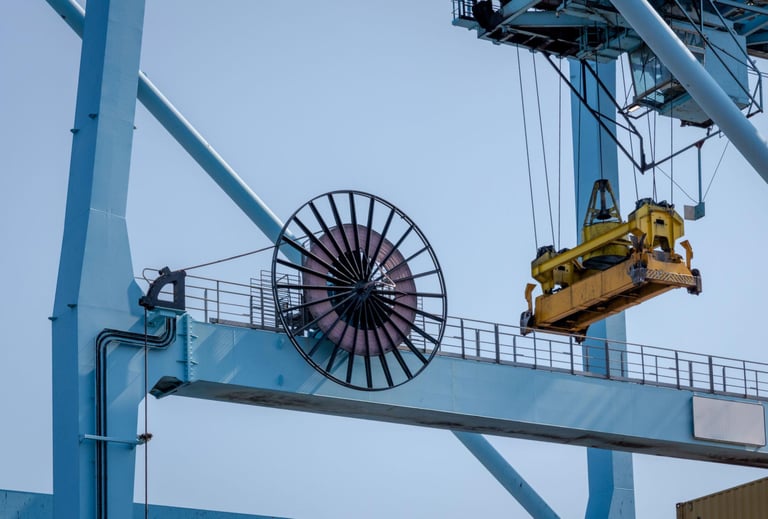
Ship-to-Shore (STS) Cranes: Supplies power to main trolley drives, enduring dynamic flex cycles and UV exposure.
3. Bulk Material Handling and Mining
Facilities handling iron ore, coal, grain, and mineral processing rely on mobile equipment running on long tracks.
Conveyor Tripper Cars and Stacker-Reclaimers: Manages continuous linear travel over hundreds of meters, where high tensile strength (25 N/mm²) prevents cable stretching.
Industrial Transport Systems: Powers automated transfer cars and dynamic machinery operating in dusty, high-vibration plants.
Performance in the Australian Operating Environment
Industrial operations across Australia face tough site conditions. Equipment must withstand high solar heat, intense UV rays, salt air mist, and abrasive mineral dust.
Here is how the TROMMELFLEX PUR-HF D12Y11YU11Y design matches key Australian operating requirements:
High UV Solar Radiation and Ambient Heat
In Queensland, Western Australia, and the Northern Territory, summer ambient temperatures frequently exceed +40°C, while direct solar radiation drives cable surface temperatures even higher.
The Challenge: High heat and intense sunlight break down standard PVC plasticizers, causing jackets to harden, crack, and admit moisture.
The Solution: The UV-stabilized polyurethane outer sheath resists solar radiation and operates in ambient temperatures up to +80°C without cracking.
Abrasive Mineral Dust and Mining Grit
In the Pilbara and Hunter Valley, mining facilities move millions of tonnes of coal, iron ore, and mineral sands.
The Challenge: Fine abrasive dust gets trapped on reel flanges, guide pulleys, and trolley tracks, grinding away standard cable jackets.
The Solution: Polyurethane offers higher abrasion, tear, and cut-growth resistance than standard rubber sheaths, extending cable service life in dusty sites.
Coastal Salt Air and Wet Season Submersion
Ports in Dampier, Port Hedland, Newcastle, and Gladstone face salt-laden coastal mist, while tropical wet seasons bring heavy downpours that flood cable trenches.
The Challenge: Moisture ingress causes conductor corrosion and earth insulation faults.
The Solution: The D12Y11YU11Y cable is rated for continuous underwater submersion down to 50 meters depth. Its tough PUR outer sheath prevents salt air and water from reaching internal conductors.
Installation Best Practices and Selection Advice
To achieve maximum service life from D12Y11YU11Y reeling cables, follow these key installation guidelines:
1. Pay Out Cable Without Introductions of Twist
Never pull cable over the flange of a stationary reel. Mount the shipping drum on a jacked axle payout stand and pull the cable off linearly. Introducing axial twist during installation shortens flex life and damages internal core layouts.
2. Respect Minimum Bending Radii
Ensure all reel drum barrels, guide sheaves, changeover rollers, and festoon saddles meet or exceed the minimum dynamic bending radius limit of 6 times the overall cable diameter (6 x D). Larger drum diameters reduce mechanical stress on internal conductors.
3. Verify Operational Tensile Load Limits
Calculate maximum tension during drum acceleration and braking. Verify that overall pulling force stays within the maximum allowable limit of 25 N/mm² of total copper cross-section.
4. Account for Multi-Layer Reel Thermal Derating
When operating cables on multi-layer spooling drums, heat buildup cannot dissipate as effectively as in free air. Apply proper thermal derating factors per DIN VDE 0298-4 to prevent thermal overload.
Conclusion
The TROMMELFLEX PUR-HF D12Y11YU11Y is a specialized low-voltage reeling cable engineered for equipment operating under dynamic motion and high mechanical stress. By combining Class 5 flexible copper conductors, halogen-free polyester insulation, embedded anti-torsion open braiding, and dual Polyurethane (PUR) sheaths, this cable delivers high mechanical strength, dynamic flexibility, and weather resistance.
For port operators, mining facilities, and crane engineers across Australia looking to optimize equipment uptime, sourcing high-specification reeling cables—such as those supplied by Feichun—ensures reliable performance across heavy lifting, material handling, and port applications.
How to Reach Us
Get in Touch
SiteMap
Product Catalogue
Festoon Cable
Shore Power Cable


Scan to add us on WeChat