High-Performance Flat Medium-Voltage Reeling Cable Engineering: A Complete Technical Guide to (N)TSFLCGEWÖU Cable Solutions for Space-Constrained Heavy Machinery and Port Infrastructure
Discover how the (N)TSFLCGEWÖU flat medium-voltage reeling cable delivers space-saving flexibility, superior mechanical endurance, and high-voltage power transmission for container cranes, excavators, and compact heavy machinery across Australia's port terminals and industrial sites.
hongjing.Wang@Feichun
7/22/202617 min read
1. Introduction
In modern heavy industrial operations and automated port terminals, power transmission infrastructure faces a unique dual challenge: handling high electrical voltages while operating within severely restricted mechanical physical spaces. On massive Ship-to-Shore container cranes at major maritime gateways like Port Botany, Port of Melbourne, and the Port of Brisbane, as well as on compact rotary excavators in Queensland's mining hubs, electrical cables are subjected to continuous dynamic tensile loads, high travel speeds, and repeated directional changes across tight roller arrays. In these compact, highly dynamic routing paths, conventional round power cables can prove impractical. Their bulky outer profiles require wider guide sheaves, larger reeling drums, and extensive lateral clearance, increasing machine deadweight and restricting operational maneuverability.
To address these spatial and mechanical constraints, specialized electrical cable design has evolved beyond standard round geometries to flat cable profiles. The Protolon (FL) (N)TSFLCGEWÖU cable represents an advanced engineering standard in flat medium-voltage and high-voltage reeling cables. Specially engineered to thrive under extreme mechanical stresses, dynamic tensile loads, and single-plane multi-directional bending over roller systems, this flat cable profile offers high power density in an ultra-compact footprint.
While originally developed to meet rigorous European standards under the German DIN VDE framework, the (N)TSFLCGEWÖU cable has become an essential power solution across Australia's severe operating environments. Australian industrial infrastructure operates under weather conditions rarely matched in urban Europe: relentless solar UV exposure, extreme ambient heat exceeding forty degrees Celsius, corrosive coastal salt spray, abrasive iron ore dust, and intense tropical wet seasons. Feichun, a leading innovator in severe-duty mobile cable manufacturing, produces high-grade (N)TSFLCGEWÖU flat medium-voltage solutions engineered specifically to withstand these environmental hazards while delivering reliable continuous power.
This technical guide provides a comprehensive analysis of the Protolon (FL) (N)TSFLCGEWÖU cable series. We will explore its flat internal architecture, material construction, electrical voltage capabilities, mechanical operating parameters, and real-world performance advantages across container cranes, excavators, festoon arrangements, and compact reeling systems.
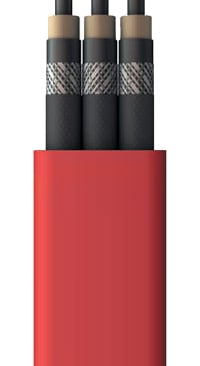
2. What Is Protolon (FL) (N)TSFLCGEWÖU?
To understand the engineering logic behind the Protolon (FL) (N)TSFLCGEWÖU cable, it is helpful to examine its designation under the standard VDE (Verband der Elektrotechnik) nomenclature system:
PROTOLON represents the premium family of heavy-duty medium-voltage flexible reeling cables engineered for continuous dynamic motion.
(FL) explicitly designates the flat structural profile of the cable assembly (Flachleitung), where cores are aligned side-by-side in a single plane rather than twisted concentrically into a round cross-section.
(N) signifies that the cable is built in accordance with national VDE design standards or VDE-based specifications.
TS highlights special heavy-duty reeling and trailing characteristics (Trommelbare Sonderausführung), engineered specifically to endure dynamic tensile forces, high-speed reel spooling, and roller guidance.
FL reiterates the specialized flat core arrangement designed for single-plane bending.
C indicates the presence of a concentric copper screen or distributed earth system surrounding the phase conductors to ensure balanced field distribution and grounding protection.
G designates high-grade rubber insulation (Gummi), specifically special Ethylene Propylene Rubber (EPR) compounds designed for medium-voltage dielectric strength.
E highlights inner and outer semi-conductive stress-control layers (Leitschichten) over the phase conductors and insulation.
W specifies weather, ozone, and ultraviolet light resistance (Wetterbeständig).
Ö highlights oil and petroleum-based fluid resistance (Ölbeständig).
U denotes flame-retardant outer rubber sheathing (Ummantelung / Unbrennbar).
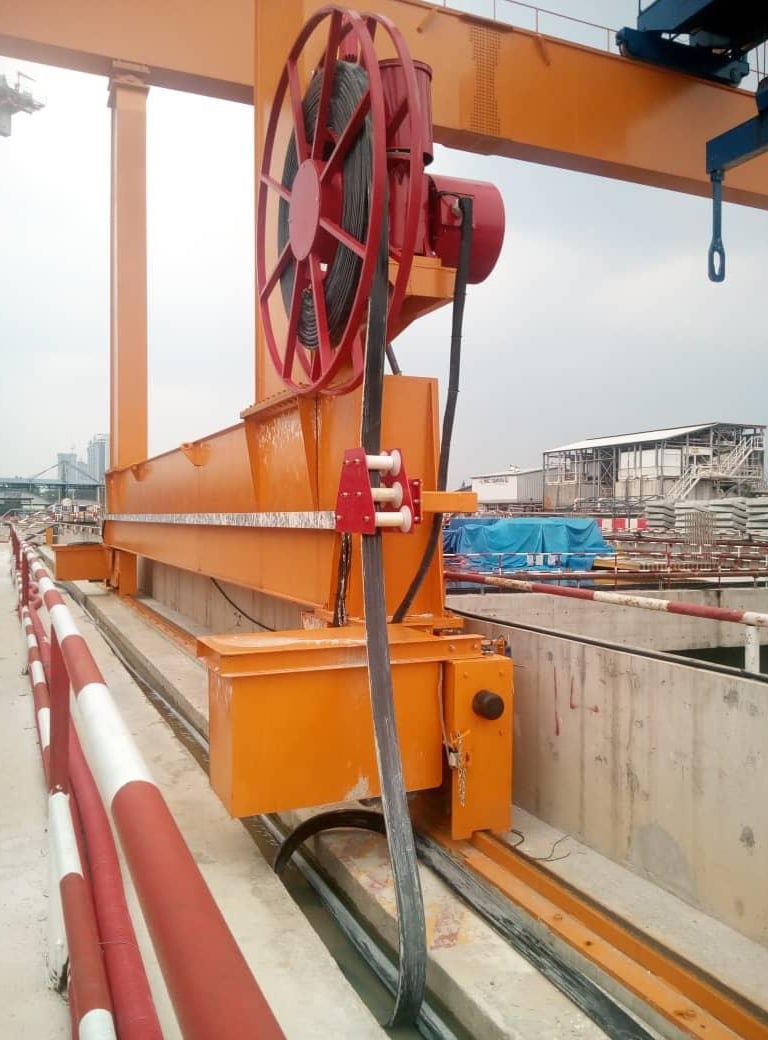
Fundamentally, (N)TSFLCGEWÖU is a flexible, flat, rubber-sheathed medium-voltage power cable built for dynamic energy transmission in systems where space is at a premium. By arranging phase cores parallel to one another in a flat plane rather than in a round bundle, the cable achieves a significantly lower physical profile height. This allows it to flex smoothly around tight roller diameters and stack neatly inside compact festoon loops or narrow reeling drums.
Furthermore, the product family includes options featuring integrated fiber optic cores. By combining medium-voltage power delivery and high-bandwidth optical data transmission within a single flat rubber profile, equipment operators can control automated gantry cranes and monitor remote machine diagnostics without trailing a second, vulnerable signal cable.
3. Application Profile and Operational Scope
The operational design of the Protolon (FL) (N)TSFLCGEWÖU cable is specifically focused on machinery where the power supply cable follows a guided, controlled path and undergoes repeated mechanical motion within a single primary bending plane.
Unlike round trailing cables, which are designed to absorb multi-axial twisting and torsional forces from unguided multi-directional motion, flat cables are optimized for single-plane deflection. When a flat cable passes over guide rollers, sheaves, or drum surfaces, the bending stress is distributed uniformly across the width of the parallel core structure. This eliminates the uneven tension and compression differential that often affects outer cores in round cables during tight single-plane flexing.
Key application environments for the (N)TSFLCGEWÖU cable include:
Maritime container handling terminals, particularly Ship-to-Shore (STS) cranes, Rail-Mounted Gantry (RMG) cranes, and Rubber-Tired Gantry (RTG) cranes operating along wharf tracks.
Large mobile excavation equipment, such as bucket-wheel excavators, rotary blast-hole drills, and mobile crushers operating in open-cut mining pits.
High-speed motorized reel systems and festoon cable carriers mounted on overhead traveling cranes, steel mill chargers, and material stacker/reclaimers.
Space-constrained industrial machinery where routing channels, guide troughs, or roller brackets lack the width required for bulky round medium-voltage cables.
In all these scenarios, the primary operational demand is continuous reliability under repeated bending cycles, elevated travel speeds up to 120 metres per minute, and severe ambient weathering.
4. Cable Design and Construction
The structural integrity and dynamic flexibility of the Protolon (FL) (N)TSFLCGEWÖU cable rely on a meticulously engineered multi-layer construction. Each element, from the copper conductor strands to the outer polychloroprene sheath, is selected to maintain electrical stability and mechanical strength under constant flexure.
4.1 Conductor System
At the core of the power delivery system are finely stranded phase conductors manufactured from electrolytic tinned copper. To maximize flex fatigue resistance and support continuous dynamic motion, the conductors conform to Class F fine-wire flexibility standards under DIN VDE 0295.
The use of electrolytic tinned copper provides essential chemical protection. The tin plating forms a physical barrier that prevents direct chemical contact between the raw copper metal and the active sulfur compounds present in the surrounding rubber insulation during high-temperature vulcanization and long-term operation. Furthermore, tinned copper provides superior corrosion resistance in humid, salty, or wet environments—a vital requirement for port cranes operating in coastal salt-air atmospheres and open-cut mines exposed to acidic pit water. The fine stranding allows individual copper wires to slide smoothly past one another as the flat cable flexes over rollers, preventing work-hardening and conductor breakage.
4.2 Core Arrangement and Split Earth Architecture
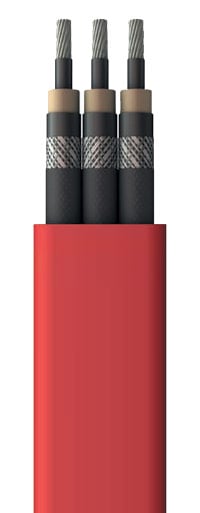
The defining structural feature of the (N)TSFLCGEWÖU cable is its parallel core arrangement. Rather than twisting the insulated phase cores together in a spiral lay, the three primary phase conductors are laid out side-by-side in a horizontal plane.
To ensure electromagnetic balance, localized earth fault protection, and a uniform physical profile, the protective earth conductor is split into multiple equal parts. Each individual phase core is concentrically encircled by its own dedicated split tinned copper earth screen. This concentric earth distribution around each phase core provides several structural and electrical benefits:
It creates a symmetrical 100% electrical earth screen around every individual power phase, guaranteeing immediate trip protection in the event of mechanical penetration or insulation damage.
It distributes the copper mass evenly across the cross-sectional geometry of the flat cable, preventing uneven weight distribution during high-speed movement over guide rollers.
It maintains a sleek, flat geometric profile that stacks perfectly without lumpiness or high spots.
4.3 Insulation System
The dielectric insulation system is built using PROTOLON special rubber compound based on high-quality Ethylene Propylene Rubber (EPR), meeting or exceeding the 3GI3 quality level under DIN VDE 0207 Part 20.
This specialized EPR compound is engineered to deliver high dielectric strength, low thermal loss, and outstanding mechanical elasticity. It retains its physical flexibility and electrical insulation integrity even under continuous thermal cycling, high operating temperatures, and severe mechanical vibration.
4.4 Field Control System
Medium-voltage power systems operating above three kilovolts generate intense electrical field stress across the insulation boundary. To prevent internal partial discharge, electrical treeing, and localized dielectric breakdown, the (N)TSFLCGEWÖU cable features a dual semi-conductive field control system:
An inner semi-conductive layer composed of specialized EPR compound applied directly over the tinned copper phase conductor.
An outer semi-conductive layer composed of modified EPR compound applied over the outer surface of the primary EPR insulation.
Crucially, the outer semi-conductive layer is formulated to be fully removable in a warm condition during termination and splicing. This feature greatly simplifies field installation and jointing for site electricians, allowing clean, quick stripping without damaging the underlying primary EPR insulation surface.
4.5 Sheath System
External physical protection for the internal core assembly is provided by the PROTOFIRM sheath system. This heavy-duty outer jacket is manufactured from a premium synthetic Chloroprene Rubber (CR) compound, conforming to at least the 5GM5 quality standard under DIN VDE 0207.
The PROTOFIRM sheath is specifically formulated to resist severe mechanical wear, tearing, cutting, oil exposure, ozone, and direct flame. Finished in a high-visibility red color, the sheath ensures clear visual identification against dark wharf decks, concrete tracks, and earthworks, reducing the risk of accidental vehicle impact. The compound is heavily stabilized against ultraviolet radiation, ensuring that extended exposure to Australia’s high UV index will not cause surface cracking, hardening, or jacket degradation.
4.6 Industrial Marking
For complete traceability and quality verification in industrial supply chains, every length of cable is permanently marked along its outer sheath. The standard marking format includes:
PROTOLON (FL) (N)TSFLCGEWÖU (number of cores) x (cross-section) (rated voltage) (year of manufacture) (serial number).
This clear identification allows site engineers to verify voltage ratings, cross-sectional areas, and batch manufacturing details directly on site prior to commissioning.
5. Electrical Ratings and Technical Standards
The Protolon (FL) (N)TSFLCGEWÖU cable is designed and manufactured in full compliance with DIN VDE 0250 Part 813, establishing verified electrical performance across a broad spectrum of industrial voltage classes.
5.1 Voltage Levels
The cable family is available across three primary nominal voltage classes ($U_0/U$):
3.6 / 6 kV and 4.2 / 7.2 kV rated voltage class.
6 / 10 kV and 6.9 / 12 kV rated voltage class.
8.7 / 15 kV rated voltage class.
5.2 Maximum Permissible Operating Voltages
To accommodate power grid fluctuations and diverse electrical supply configurations, the cable is rated for elevated maximum operating voltages in both alternating current (AC) and direct current (DC) power systems:
Maximum Permissible AC System Operating Voltages ($U_0/U$):
For 4.2/7.2 kV nominal cables: Maximum permissible AC voltage of 4.2 / 7.2 kV.
For 6.9/12 kV nominal cables: Maximum permissible AC voltage of 6.9 / 12 kV.
For 8.7/15 kV nominal cables: Maximum permissible AC voltage of 10.4 / 18 kV.
Maximum Permissible DC System Operating Voltages ($U_0/U$):
For 4.2/7.2 kV nominal cables: Maximum permissible DC voltage of 5.4 / 10.8 kV.
For 6.9/12 kV nominal cables: Maximum permissible DC voltage of 9 / 18 kV.
For 8.7/15 kV nominal cables: Maximum permissible DC voltage of 13.5 / 27 kV.
5.3 Test Voltages and Current Carrying Capacity
Every production length undergoes high-voltage factory routine testing according to DIN VDE 0250 Part 813 to verify dielectric strength:
4.2/7.2 kV rating: AC test voltage of 11.0 kV.
6.9/12 kV rating: AC test voltage of 17.0 kV.
8.7/15 kV rating: AC test voltage of 24.0 kV.
The continuous current-carrying capacity of the cable is calculated in accordance with DIN VDE 0298 Part 4. In specific industrial applications where unique cooling conditions or short-duty cycles apply, higher operating currents may be permissible upon detailed engineering evaluation.
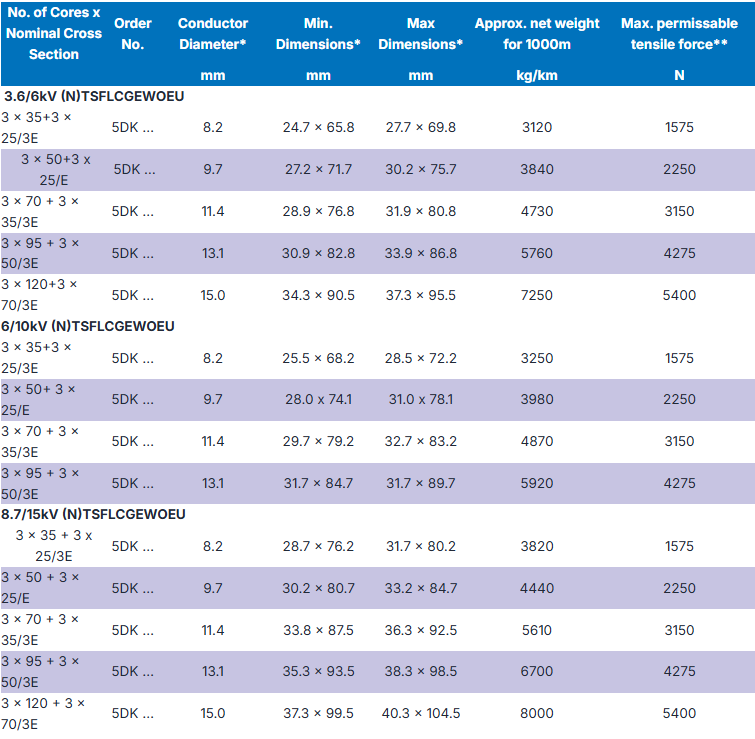
6. Mechanical Performance and Dynamic Motion Limits
The mechanical performance parameters of the Protolon (FL) (N)TSFLCGEWÖU cable reflect its specialization for heavy-duty, high-speed mobile equipment:
Maximum Permissible Tensile Load: The cable is engineered to withstand dynamic pull forces up to 15 Newtons per square millimetre (15 N/mm²) of total phase conductor cross-section, fully compliant with DIN VDE 0298 Part 3. This high tensile strength ensures stable payout and winding during rapid machine acceleration.
Torsional Stress Handling: Torsional stress is strictly not applicable (n/a) for this cable family. Flat cables are designed exclusively for single-plane bending. They must not be subjected to axial twisting during installation or operation.
Minimum Bending Radii: Minimum bending radii are specified according to DIN VDE 0298 Part 3. For optimal operational lifespan, the recommended applied cable outer dimension (OD) when designing guide sheaves and rollers is 1.5 times the overall height of the flat cable profile.
S-Type Directional Change Clearance: When the cable path involves S-type reverse directional changes across roller sets, the minimum distance between adjacent reverse bend points must be at least 20 times the cable profile height ($20 \times D$). This recommended clearance allows internal mechanical stresses to equalize between directional reversals.
Gantry Travel Speed: The cable is rated for continuous motorized reeling operation on mobile gantries at travel speeds up to 120 metres per minute (120 m/min).
Mechanical Testing Rigor: The cable design undergoes rigorous reversed bending testing and continuous reeling testing during qualification to guarantee long-term fatigue resistance under uninterrupted field duty.
7. Environmental Resistance and Thermal Limits
Industrial sites across Australia expose electrical equipment to extreme thermal ranges and aggressive chemical conditions. The (N)TSFLCGEWÖU cable is built to remain operational across these environmental extremes.
7.1 Temperature Ratings
Fully Flexible Dynamic Operation: Minus 35 degrees Celsius to plus 80 degrees Celsius (-35°C to +80°C). The rubber compounds remain resilient and highly flexible even in cold freezer terminals or sub-zero overnight desert temperatures.
Fixed Static Installation: Minus 50 degrees Celsius to plus 80 degrees Celsius (-50°C to +80°C).
Maximum Conductor Operating Temperature: Plus 90 degrees Celsius (+90°C) continuous operating temperature under full electrical load.
Maximum Short-Circuit Conductor Temperature: Plus 250 degrees Celsius (+250°C) for up to five seconds during electrical fault conditions.
7.2 Weather, Chemical, and Water Resistance
Oil Resistance: Fully compliant with DIN VDE 0473 Part 811-2-1 Paragraph 10, preventing sheath softening or swelling when exposed to hydraulic oils, lubricants, or diesel fuel splatters.
Weather and Radiation Resistance: Approved for unrestricted outdoor and indoor use. The outer PROTOFIRM sheath exhibits outstanding resistance to atmospheric ozone, intense ultraviolet (UV) sunlight, and ambient moisture.
Water Compatibility: Tested and verified for continuous water compatibility according to HD 2216 standards, ensuring long-life reliability in wet environments, coastal splash zones, and damp underground pits.
8. Why Flat Design Matters in Space-Constrained Systems
The physical geometry of an electrical power cable fundamentally dictates the design of the mechanical handling system supporting it. While round medium-voltage cables are well suited for multi-axis movement, they introduce spatial inefficiencies when applied to guided single-plane machinery.
A round medium-voltage cable requires a relatively large outer diameter to accommodate concentric phase stranding, inner fillers, anti-twist braids, and outer jacketing. When multiple round cables are required, or when a high-voltage cable must be stored on a mobile gantry, the resulting physical bulk requires wide reeling drums, heavy guide sheaves, and large structural support frames.
By contrast, the flat profile of the Feichun (N)TSFLCGEWÖU cable arranges phase conductors in a single side-by-side row. This layout yields several major practical benefits:
Minimal Profile Height: The flat profile significantly reduces the vertical height of the cable. This allows the cable to bend around smaller roller diameters without inducing excessive outer jacket strain or core compression.
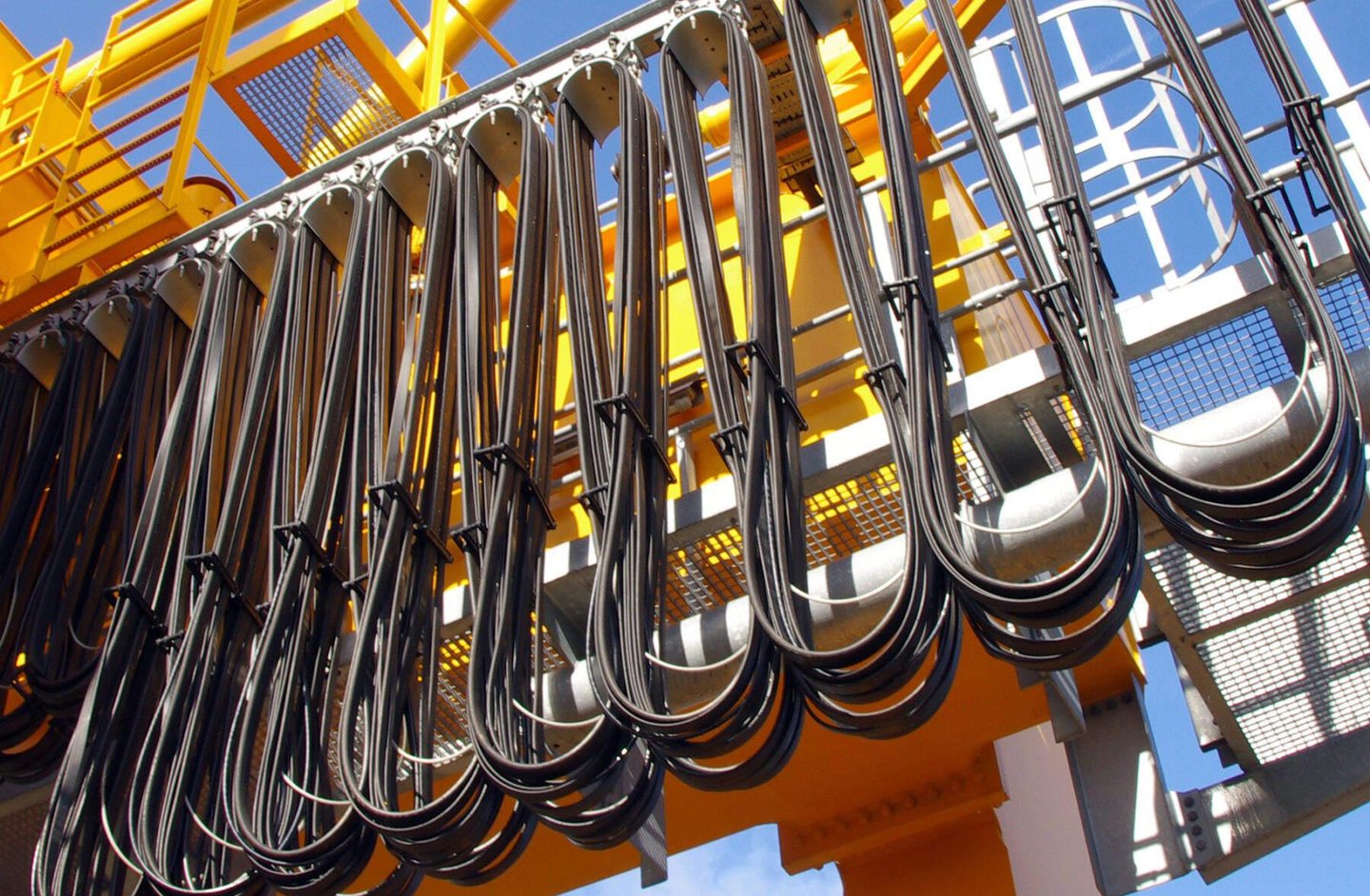
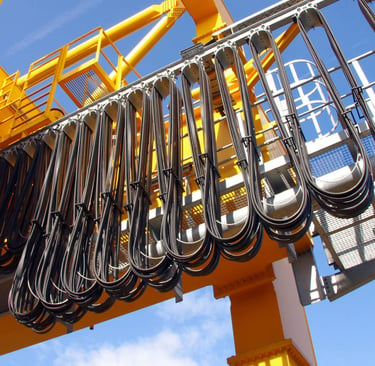
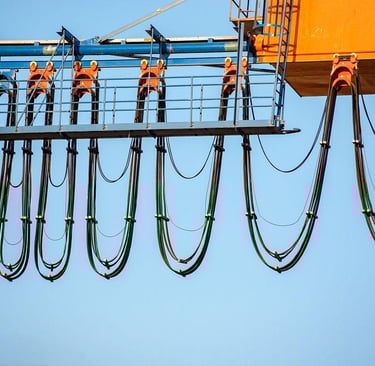
Compact Stacking and Festooning: In festoon cable systems and guide troughs, flat cables stack neatly on top of one another in compact layers. This reduces the total physical envelope required for cable storage, allowing machine designers to narrow the gantry structure and reduce overall crane deadweight.
Superior Heat Dissipation: In a flat core arrangement, every phase conductor sits directly adjacent to the outer sheath, maximizing surface area exposure. This enables more efficient heat dissipation compared to round cables, where inner cores are thermally trapped beneath surrounding outer layers.
Smooth Roller Tracking: The broad, flat bottom surface of the cable provides a stable contact patch across guide rollers. This prevents the lateral sliding, twisting, and edge wear that round cables often experience when riding in flat roller channels.
For engineering teams designing modern high-efficiency mobile machinery, the flat geometry of (N)TSFLCGEWÖU provides an elegant solution for delivering high medium-voltage power through restricted mechanical spaces.
9. Container Crane Applications in Maritime Ports
Maritime container terminals represent one of the most demanding operational arenas for medium-voltage reeling cables. Modern automated container terminals operate 24 hours a day, moving thousands of heavy shipping containers between ocean vessels and port yards.
At major Australian container gateways—such as Port Botany in Sydney, the Port of Melbourne, Port of Brisbane, and Fremantle Port—Ship-to-Shore (STS) cranes and Rail-Mounted Gantry (RMG) cranes travel along extensive wharf tracks at high speeds. These massive cranes depend on continuous medium-voltage power (typically 6.6 kV or 11 kV) delivered via motorized cable reels or festoon systems.
The Protolon (FL) (N)TSFLCGEWÖU cable is engineered specifically for container crane service:
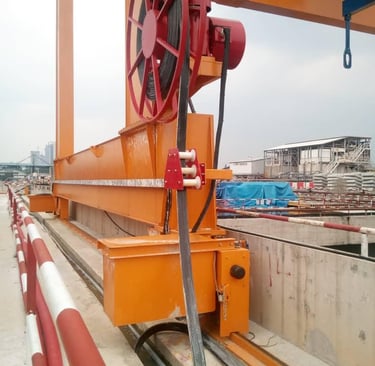
Roller-Guided Reeling: STS container cranes feature complex cable payout paths with multiple guide rollers, tension sheaves, and directional change brackets. The flat profile of (N)TSFLCGEWÖU tracks perfectly across these roller arrays at travel speeds up to 120 metres per minute without twisting or derailing.
Salt Spray and Coastal UV Protection: Wharf cranes operate in salt-laden coastal marine environments under direct solar exposure. Feichun's heavy-duty synthetic rubber compounding resists salt-water degradation, ozone cracking, and high ambient solar heating.
Integrated Optical Data: Container cranes rely heavily on real-time data feeds for automated positioning, quay container scanning, and remote control. The integrated fiber optic core option allows high-voltage power and gigabit fiber data to be fed to the crane trolley simultaneously through a single space-saving flat cable assembly.
10. Heavy Crane, Excavator, and Industrial Machinery Applications
Beyond container ports, the (N)TSFLCGEWÖU cable provides reliable dynamic power across a wide variety of heavy mobile industrial equipment operating in harsh environments.
10.1 Open-Cut Excavators and Rotary Drills
In Australia’s mining regions, such as the Pilbara iron ore operations and the Bowen Basin coal mines, large electric excavators, bucket-wheel reclaimers, and rotary blast-hole drills operate continuously on open pit floors.
These machines frequently travel along fixed or guided pit paths, pulling medium-voltage power cables behind them over guide rollers and tension arms. The rugged PROTOFIRM chloroprene rubber sheath of the (N)TSFLCGEWÖU cable provides total protection against sharp rock fragments, iron ore dust, acidic pit water, and extreme pit surface temperatures that often exceed sixty degrees Celsius during summer.
10.2 Overhead Traveling Cranes and Steel Mill Machinery
In heavy manufacturing, scrap yards, and steel processing plants, large overhead traveling cranes and charging cars operate over short, high-frequency travel paths. Space inside industrial plant bays is highly restricted, leaving little room for heavy round cable reels.
Using flat (N)TSFLCGEWÖU cables on compact festoon systems allows plant operators to supply 6.6 kV or 11 kV power to high-capacity hoist motors without sacrificing valuable bay headroom or hook travel distance.
11. Festoon Systems and Guided Cable Tracks
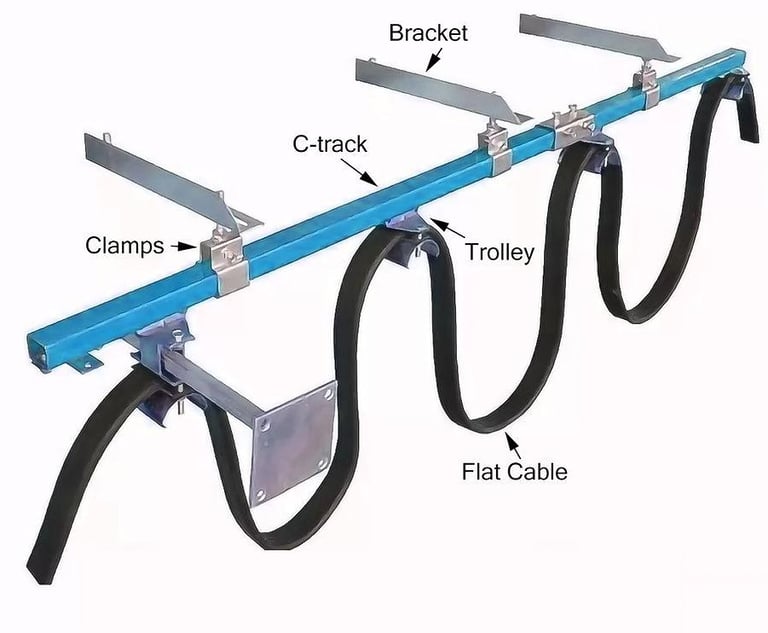
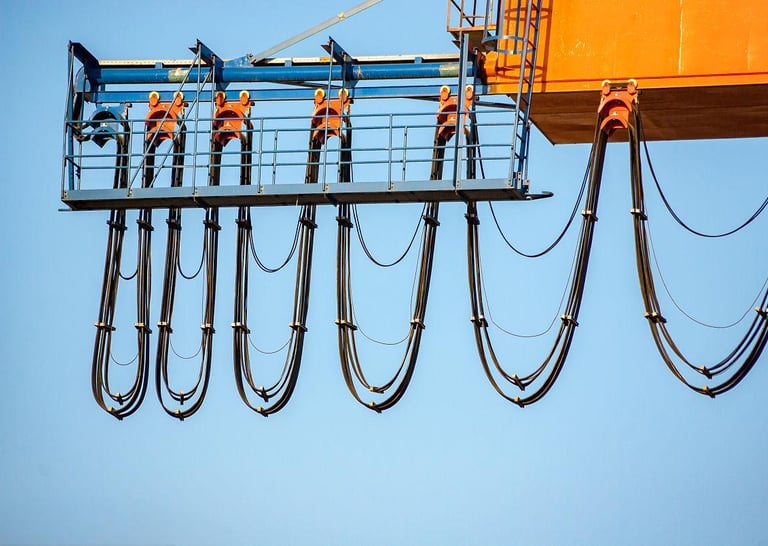
Festoon systems and guided roller tracks represent ideal mechanical environments for flat medium-voltage cables. In a festoon system, the cable is suspended in loops from trolley cars that ride along an overhead I-beam or guide rail. As the mobile machine moves back and forth, the festoon loops gather together or extend fully along the rail.
When round cables are used in heavy-duty festoon systems, the repeated looping and unlooping motion can cause individual round cables to twist, tangle, or rub against one another, leading to premature sheath wear.
Flat (N)TSFLCGEWÖU cables eliminate these festoon operational issues:
Uniform Loop Formation: The flat profile naturally bends in a single predictable direction, forming clean, uniform catenary loops that collapse neatly without tangling or crossing over adjacent lines.
Clamping Stability: Flat cables can be clamped securely across their full width in festoon trolley saddles. The broad clamping surface distributes holding pressure evenly across all cores, preventing localized core crushing or conductor deformation.
Compact Trough Routing: In guided roller troughs and gantry channels, flat cables lie flat against the base, maintaining a low center of gravity and preventing lateral movement during rapid acceleration and braking cycles.
12. Modern Alternative and Upgrade Solutions
When site maintenance teams and plant engineers evaluate replacement options for damaged power lines or upgrading legacy machinery, they must choose between traditional round trailing cables and modern flat reeling alternatives.
Conventional round medium-voltage cables remain common for general unguided mobile equipment. However, when deployed in tight roller channels, narrow reels, or festoon systems, round cables frequently exhibit operational drawbacks: lateral slipping off narrow guide rollers, excessive heat retention in multi-layer reel windings, and high physical bulk that demands heavy support structures.
The Feichun (N)TSFLCGEWÖU flat cable family serves as an ideal modern replacement and upgrade solution for space-constrained mobile equipment. Replacing bulky round cables with Feichun (N)TSFLCGEWÖU flat cables provides immediate operational gains:
Reduced Mechanical Weight: Lower profile height and optimized split-earth geometry reduce overall cable mass, lowering motor torque requirements on reeling drives and reducing stress on guide structures.
Elimination of Torsional Corkscrewing: Because the cable operates strictly in single-plane bending over rollers, the accumulation of internal rotational torque is completely eliminated, preventing conductor corkscrewing.
Combined Power and Communication: By upgrading to (N)TSFLCGEWÖU variants with integrated fiber optic cores, operations can replace separate power and signal cables with a single integrated flat cable line, simplifying cable management and reducing maintenance points.
13. Cable Selection and Engineering Procurement Guide
Selecting the optimal Protolon (FL) (N)TSFLCGEWÖU cable for a specific industrial application requires careful verification of electrical, mechanical, and environmental criteria. Engineering teams and procurement managers should utilize the following step-by-step evaluation framework:
Verify System Voltage Class: Confirm the nominal supply voltage of the distribution grid and equipment. Select from 4.2/7.2 kV, 6.9/12 kV, or 8.7/15 kV ratings to ensure proper dielectric insulation thickness and routine factory test voltage compliance (up to 24 kV AC).
Determine Current Load and Conductor Cross-Section: Calculate continuous operating current requirements, applying necessary thermal derating factors for high ambient Australian summer temperatures, solar radiation exposure, and festoon loop packing. Select conductor sizes ranging from 35 mm² up to 120 mm² phase cross-sections.
Assess Motion Profile and Roller Geometry: Evaluate the machine's travel path. Ensure all movement occurs within a single primary bending plane. Verify that guide roller sheaves provide a minimum applied cable OD equal to 1.5 times the flat cable height, and maintain at least 20×D spacing between S-type reverse bends.
Confirm Travel Speed and Tensile Pull: Check gantry travel speeds against the 120 m/min rating, and verify that dynamic reel acceleration forces do not exceed the 15 N/mm² maximum permissible tensile load limit.
Identify Fiber Optic Requirements: Determine whether real-time data transmission, automated PLC control, or video monitoring is required. If so, specify integrated fiber optic versions within the product order.
Check Environmental Exposure: Ensure the outer PROTOFIRM chloroprene rubber sheath matches site chemical exposure, salt spray, oil presence, and HD 2216 water immersion requirements.
14. Conclusion
In modern heavy industrial applications, container handling terminals, and open-pit mining operations, delivering medium-voltage electrical power through restricted mechanical spaces demands specialized cable engineering. Standard round cables, while effective for unguided general motion, often prove too bulky, heavy, and mechanically inefficient for tight roller arrays, compact reels, and high-density festoon systems.
The Protolon (FL) (N)TSFLCGEWÖU flat medium-voltage reeling cable offers an outstanding engineering solution to these physical and operational challenges. Featuring Class F fine-wire tinned copper conductors, symmetrical split-earth screening, high-dielectric EPR insulation, a dual strippable field control system, and a rugged PROTOFIRM chloroprene rubber sheath, (N)TSFLCGEWÖU delivers exceptional electrical reliability in an ultra-compact flat profile.
For Australian industrial operators managing high travel speeds, severe solar heat, abrasive dust, and aggressive production schedules, Feichun’s (N)TSFLCGEWÖU flat cable range delivers long-term durability and peace of mind. By adopting flat medium-voltage cable technology, plant engineers can reduce machine structural weight, optimize festoon space, improve motor efficiency, and ensure uninterrupted power and data delivery across the most demanding industrial environments in Australia.
15. Frequently Asked Questions (FAQ)
What does the designation (N)TSFLCGEWÖU stand for?
The designation follows German VDE standard naming conventions. It indicates a VDE-style (N), heavy-duty reeling cable (TS) with a flat structural profile (FL), concentric split earth screening (C), synthetic EPR rubber insulation (G), semi-conductive stress-control layers (E), weather/ozone/UV resistance (W), oil resistance (Ö), and flame-retardant outer rubber sheathing (U).
How does a flat cable profile differ from a standard round medium-voltage cable?
In a flat cable, the phase conductors are arranged side-by-side in a single horizontal plane rather than twisted concentrically into a round bundle. This flat geometry significantly reduces the overall height profile of the cable, making it ideal for bending over single-plane guide rollers, stacking neatly in compact festoon systems, and dissipating operational heat more efficiently.
Can (N)TSFLCGEWÖU cable handle torsional twisting?
No. Torsional stress is strictly not applicable (n/a) to flat cables. (N)TSFLCGEWÖU cables are designed exclusively for single-plane bending over rollers, sheaves, and reeling drums. They must be installed in guided systems where axial twisting is prevented.
What are the main applications for Protolon (FL) (N)TSFLCGEWÖU cable?
Primary applications include Ship-to-Shore (STS) container cranes, Rail-Mounted Gantry (RMG) cranes, rubber-tired gantry cranes, bucket-wheel excavators, rotary blast-hole drills, mobile crushers, high-speed festoon cable carriers, and industrial overhead cranes operating in space-limited environments.
What fiber optic options are available in this flat cable family?
The product range includes integrated fiber optic variants designated as PROTOLON (FL) LWL. These cables incorporate protective optical fiber elements within the flat rubber profile, allowing simultaneous high-voltage electrical power delivery and high-bandwidth optical data transmission for machine automation and telemetry.
Is the cable suitable for Australia's harsh outdoor climate?
Yes. The cable features a high-grade PROTOFIRM Chloroprene Rubber outer sheath specifically formulated for unrestricted outdoor use. It exhibits exceptional resistance to intense ultraviolet (UV) radiation, atmospheric ozone, coastal salt spray, oil contact, and ambient temperature extremes ranging from -35°C during dynamic flexing up to +80°C outdoors, with continuous conductor operating temperatures up to +90°C.
How to Reach Us
Get in Touch
SiteMap
Product Catalogue
Festoon Cable
Shore Power Cable


Scan to add us on WeChat