Mastering Vertical Spreader Cables: The Complete Guide to 3GSLTÖ in Gravity-Fed Collector Basket Systems
Overview of 3GSLTÖ flexible spreader cable for gravity-fed collector basket systems, explaining type meaning, basket working principle, cable flexibility and tensile requirements, and key applications on container cranes and automated vertical handling equipment.
hongjing.Wang@Feichun
7/20/202610 min read
Industrial material handling systems operating under intense vertical mechanics demand purpose-engineered cable architectures. Standard trailing cables or conventional horizontal festoon lines quickly succumb to core migration, birdcaging, and premature sheath degradation when subjected to heavy dynamic drop forces.
Within high-stress vertical operations, Feichun 3GSLTÖ emerges as a specialized, flexible spreader cable engineered specifically to excel in vertical basket (collector basket) systems. Operating as the central feed cable for load-lifting attachments—most notably high-duty spreaders on container cranes—3GSLTÖ works exclusively in vertical basket arrangements across dry, humid, wet, and demanding outdoor environments.
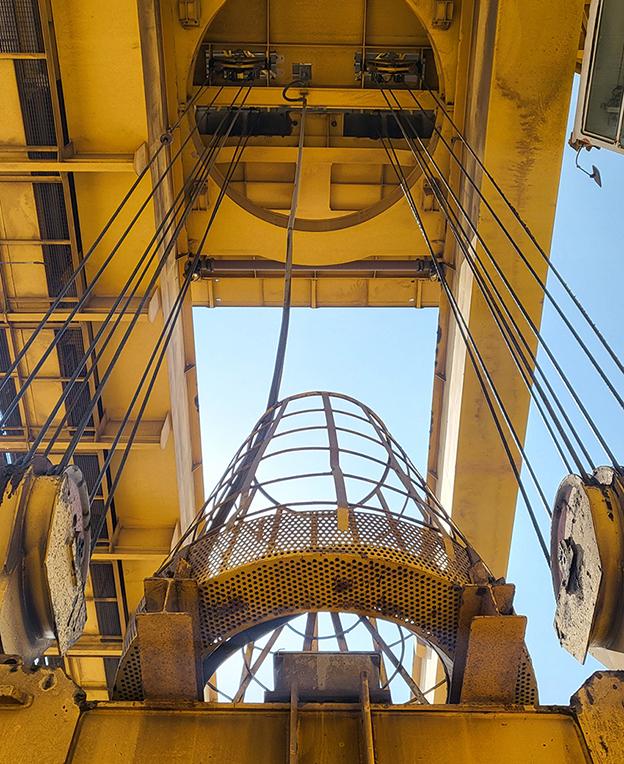
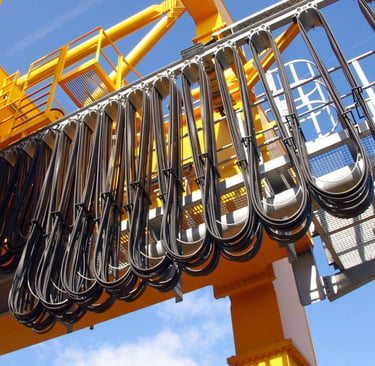
In a standard system layout, power flows from a fixed junction box suspended high on the crane superstructure. The Feichun 3GSLTÖ cable drops vertically as a free-hanging line, entering a gravity-fed collector basket mounted below. Inside this basket, the cable loops continuously under its own weight, feeding power and control signals directly down to the container crane spreader as it moves up and down.
Rather than wrapping around a motor-driven drum, the cable relies on gravity to collect, coil, and pay out within an open basket assembly during rapid hoisting cycles. This comprehensive technical guide explores how Feichun 3GSLTÖ supports gravity-fed collector basket systems in port cranes, container handling equipment, and automated vertical industrial machinery, ensuring continuous reliability, structural integrity, and maximum service life.
1. Introduction: Role of 3GSLTÖ in Collector Basket Systems
2. 3GSLTÖ Type Definition
2.1 Meaning of "3GSLTÖ"
The German DIN VDE designation standard system precisely defines a cable's structural makeup and operational envelope through its letter code:
3G: Identifies the core configuration. The numeral 3 specifies three main power cores, while the letter G (derived from the German Grün-Gelb) denotes the integration of a green/yellow protective earth conductor. Following DIN VDE color-coding standards, a 3G designation signifies three insulated power cores with a green/yellow earth conductor integrated directly into the lay-up, rather than three insulated conductors without a protective ground.
SLTÖ: Refers to the physical build and mechanical classification of the cable. The letter combination designates a Special flexible Lifting/spreader cable (Spreaderleitung) built for heavy vertical Torsion-loaded basket storage or reeling applications (Ölbeständig), equipped with oil-resistant, weather-proof outer compound sheathing.
2.2 Functional Characteristics of 3GSLTÖ
Feichun 3GSLTÖ is manufactured as a heavy-duty, low-voltage flexible cable rated at 0.6/1 kV (600/1000V). It is engineered to withstand continuous vertical movement under extreme tensile loads, rapid directional changing, and complex torsional stresses.
Unlike standard flexible trailing cables designed for linear festoons or horizontal track carriers, 3GSLTÖ is optimized for crane spreaders and collector basket configurations. In these systems, the cable hangs freely over long distances and coils into a stationary or moving basket structure rather than wrapping systematically around a drum under motor torque.
The physical cross-section of a 3GSLTÖ cable is built in concentric protective layers. At the absolute center sits a high-tensile aramid strain-relief core or earth bundle, surrounded by the insulated power cores (L1, L2, L3) and earth wire. Encasing these conductors is a soft elastomeric inner sheath layer. Above this inner layer lies a crucial anti-torsion braid woven from high-strength polyester thread, which is completely enveloped and bonded into a heavy-duty rubber PCP or PUR outer sheath. Every layer—from conductor stranding to the outer jacket—is tailored to absorb severe impact, vertical suspension stress, and continuous dynamic friction.
3. Gravity-Fed Collector Basket System: Working Principle
3.1 Structural Elements of a Collector Basket System
A gravity-fed collector basket system provides a simple, low-maintenance alternative to motorized cable reels for supplying power and control signals to vertical hoisting attachments.
The system comprises three main structural elements:
Cable Storage Basket: A circular, square, or octagonal mesh or perforated steel receptacle mounted either near the crane trolley or directly on the spreader frame.
Vertical Guide Structure: A trumpet-shaped funnel, collar, or set of guide rollers that directs the incoming cable smoothly into the basket center.
Fixed Junction Point: A strain-relieved anchor at the top or bottom of the travel path connecting the main power bus to the hanging cable length.
The cable is allowed to lay inside the basket in free, natural loops. As the crane spreader moves vertically, the system uses the cable's self-weight and gravitational force to pay out or loop the cable into the container without mechanical reel drives.
3.2 Gravity-Fed Cable Operation
When the spreader lifts toward the top of the crane frame, the distance between the spreader and the upper anchor point collapses. The excess cable drops vertically into the storage basket under its own weight. The structural flexibility and mass distribution of Feichun 3GSLTÖ allow it to coil into uniform, circular loops without twisting or tangling.
When the spreader lowers toward the container deck or ground level, gravity pulls the spreader downward, uncoiling the cable loops from the basket. The cable lifts vertically through the guide collar, extending smoothly. Because the system relies entirely on gravity and cable mass, precise control over cable flexibility, torsional stability, and outer friction coefficients is required to prevent loop disruption at high speeds.
3.3 Why Ordinary Cables Are Not Suitable
Standard trailing, festoon, or fixed-wiring cables fail quickly in gravity-fed vertical collector baskets due to structural limitations:
Lack of Torsional Neutrality: Standard flexible cables tend to twist along their longitudinal axis when dropped into open loops. Over repeated hoisting cycles, this accumulated twist causes severe "corkscrewing," leading to tangles, inner core stress, and basket overflow.
Core Migration: Without internal sheath bonding or dynamic stranding layouts, internal copper cores migrate under gravity, bunching together, distorting the cable geometry, and ultimately splitting the outer jacket.
Inadequate Tensile Resistance: Standard rubber cables depend solely on conductor copper cross-sections to support hanging weight. Over deep vertical drops, the copper stretches, altering electrical resistance and causing internal short circuits or open phases.
Sheath Abrasion: As cable loops rub against each other and basket edges at speeds up to 180 m/min to 240 m/min, standard PVC or generic rubber jackets quickly wear away, exposing inner cores.
In contrast, Feichun 3GSLTÖ utilizes Class 5 fine-stranded copper for fatigue resistance, a reinforced anti-torsion braid for balance, and heavy-duty PCP or PUR outer sheathing for maximum abrasion and oil resistance.
4. Cable Requirements for Gravity-Fed Collector Baskets
4.1 Flexibility and Continuous Movement
Vertical collector baskets subject power cables to continuous reverse bending, high-velocity entry impacts, and rapid coiling cycles. Achieving reliable long-term performance requires dynamic cable flexibility and high fatigue resistance.
Feichun 3GSLTÖ incorporates ultra-fine tinned or bare electrolytic Class 5 stranded copper conductors built in accordance with DIN EN 60228 / DIN VDE 0295 standards. These conductor bundles are insulated using high-grade, flexible Ethylene Propylene Rubber (EPR) or customized cross-linked elastomer compounds that provide a high-gliding internal surface.
A soft elastomeric inner sheath cradles the insulated power cores, acting as a dynamic shock absorber during basket entry. This construction maintains structural integrity through millions of dynamic flexing cycles without inner core friction damage.
4.2 Cable Weight and Gravity Optimization
Gravity-fed collector basket performance depends heavily on physical mass distribution. The cable must feature sufficient weight per meter to ensure predictable downward movement into the basket without floating or drifting in high quayside winds. However, it must not be excessively heavy, as over-weight cables increase suspension tension and accelerate mechanical wear on guide collars.
Feichun 3GSLTÖ carefully balances conductor cross-sections, insulation wall thickness, inner sheath density, and outer sheath compounds to achieve an optimized weight-to-diameter ratio. This calibrated mass profile ensures the cable drops straight down into the guide funnel, laying flat in predictable concentric rings at high hoisting speeds.
4.3 Tensile Strength and Suspension Force
Vertical drop configurations subject feed cables to continuous static suspension forces, supplemented by high dynamic impact spikes when the spreader accelerates downward or stops abruptly.
To prevent conductor strain, specialized spreader cables like Feichun 3GSLTÖ incorporate integrated tensile support elements. A central strain-relief member—constructed from high-tensile aramid yarns (Kevlar) or textile cores—absorbs the gravitational load of the suspended cable length.
Furthermore, an anti-torsion braid made from high-strength synthetic fibers is vulcanized between the inner and outer sheaths. This vulcanized sandwich construction prevents outer sheath twist, distributes tensile loads evenly across the cable envelope, and protects the inner conductors from mechanical stretch.
5. Typical Applications of 3GSLTÖ in Collector Basket Systems
5.1 Container Cranes and Spreader Cables
The most demanding environment for 3GSLTÖ cables is on quayside container cranes, including Ship-to-Shore (STS) cranes, Rail-Mounted Gantry (RMG) cranes, and Rubber-Tyred Gantry (RTG) cranes operating in commercial shipping ports.
On a typical STS crane, the cable hangs suspended from the main trolley structure down to the gravity collector basket mounted on the spreader unit. As the spreader moves vertically over container stacks at hoist speeds reaching 180 m/min to 240 m/min, the Feichun 3GSLTÖ cable delivers main low-voltage power (0.6/1 kV) to twistlock motors, hydraulic pumps, and control systems on the spreader.
Field Application: Port Botany & Port of Brisbane, Australia
At major container terminals in Port Botany (New South Wales) and the Port of Brisbane (Queensland), STS and RMG cranes operate continuously in harsh marine environments. The cables face high salt exposure, intense UV radiation, and ambient temperatures reaching 45°C in summer. Feichun 3GSLTÖ cables deployed in these gravity collector baskets withstand quayside winds, oil spray from spreader hydraulics, and continuous vertical impact without sheath failure or torsional distortion.
5.2 Vertical Cable Systems in Automated Warehouses
In modern high-density automated distribution hubs, Automated Storage and Retrieval Systems (AS/RS) and stacker cranes utilize vertical basket guides or vertical carrier channels to power high-speed hoisting carriages.
Mounted inside the high-bay rack structure, the stacker crane mast guides the carriage at speeds up to 240 m/min. The vertical basket housing the Feichun 3GSLTÖ cable ensures smooth payout and retrieval to the moving carriage and forks without tangling in high-speed automated environments.
Field Application: Automated Retail & Mining Logistics (Western Australia & Victoria)
Large distribution centers in Melbourne and specialized automated spare-parts facilities serving the Pilbara mining region in Western Australia rely on automated stacker cranes for round-the-clock logistics. These machines operate at high acceleration rates in narrow aisles. Feichun 3GSLTÖ cables housed in vertical collector baskets deliver smooth payout and coiling, eliminating the risk of slack-cable snagging inside automated storage racks.
5.3 Other Gravity-Fed Vertical Systems
Beyond container terminals and automated warehouses, Feichun 3GSLTÖ cables are deployed across heavy industrial vertical lifting systems:
Shipboard Crane Systems: Heavy-lift offshore vessels and bulk carriers equipped with grab buckets or vertical cargo spreaders.
Underground Mining Hoists: Shaft-inspection platforms and vertical emergency escape hoists operating in deep underground mines across the Bowen Basin (Queensland) and Kalgoorlie (Western Australia).
Industrial Vertical Lift Platforms: Heavy steel-mill lifting rigs and hydroelectric dam gate hoists where drum-reeling space is limited and gravity-fed vertical storage baskets provide a compact power feed solution.
6. Practical Selection and Design Considerations
6.1 Matching Cable Type to Basket System
Selecting the correct cable construction requires matching electrical and mechanical parameters to the operational demands of the vertical collector basket system:
Determine Electrical Load: Select conductor cross-sectional area (mm²) and voltage rating (0.6/1 kV) based on spreader motor demands.
Calculate Suspension Drop: Calculate total hanging weight during maximum extension and ensure it falls well within the cable's safe working tensile limit.
Define Basket Geometry: Verify that the storage basket diameter is at least 12 to 20 times the outer diameter of the cable to prevent tight bends and structural stress.
Assess Environment: Choose sheath compounds (PCP or PUR) based on exposure to UV light, oils, hydraulic fluids, and ambient temperature extremes.
6.2 Mechanical and Environmental Parameters
When designing or replacing cables in gravity-fed vertical systems, evaluate key engineering tolerances to ensure maximum service life:
Maximum Tensile Loading: Standard copper conductors support 15 to 20 N/mm². Feichun 3GSLTÖ designs equipped with central aramid strain-relief elements support tensile loads up to 30 N/mm², enabling deeper vertical drops and higher acceleration rates.
Maximum Permissible Twist: The integral anti-torsion polyester braid maintains structural alignment, limiting longitudinal torsional strain to ±50° per meter during rapid drop cycles.
Minimum Bending Radius: Basket entry funnels and internal storage dimensions must maintain a minimum dynamic bending radius of 6 x D for polyurethane (PUR) variants or 12 to 20 x D for heavy rubber formulations (where D is the cable outer diameter).
Maximum Travel Speed: Designed to handle rapid hoist velocities ranging from 180 m/min to 240 m/min.
Temperature Spectrum: Maintains full operational flexibility across ambient temperatures ranging from -35°C to +80°C in outdoor mobile service.
Chemical and Weather Protection: The heavy-duty PCP or PUR outer sheath resists hydraulic fluids and lubricating oils (compliant with IEC 60811-404), while offering full resistance to ozone, UV radiation, and moisture under intense sunlight.
7. Technical Specifications Overview: Feichun 3GSLTÖ Spreader Cable
To summarize the operational boundaries for engineering design, Feichun 3GSLTÖ operates under a rated voltage ($U_0/U$) of 0.6/1 kV (600/1000V), with a maximum permissible AC operating voltage of 0.7/1.2 kV and an AC test voltage rating of 3.5 kV held for 5 minutes during factory testing.
The conductor is built from Class 5 flexible bare or tinned copper compliant with DIN EN 60228 / VDE 0295. Core insulation utilizes high-grade EPR compound (minimum 3GI3), protected by a shock-absorbing PCP or elastomeric inner sheath. Structural stability is maintained via a vulcanized synthetic fiber anti-torsion braid, enclosed in a heavy-duty PCP or PUR rubber outer jacket.
The cable supports tensile loads up to 30 N/mm² with an aramid center, withstands up to ±50°/m torsional deflection, operates at hoisting speeds up to 240 m/min, and remains fully functional in outdoor temperatures from -35°C to +80°C.
8. Installation Best Practices and Conclusion
Achieving high operational reliability and maximum cable service life in gravity-fed collector basket systems requires matching purpose-engineered cables with proper installation procedures:
Unroll Correctly: Always pay out the cable directly from the shipping reel without twisting or spiraling it off the flange side.
Set Proper Strain Relief: Install specialized mesh grips or wedge clamps at the upper suspension anchor to relieve core tension before hanging.
Align Guide Funnel: Ensure entry trumpets and guide collars have smooth, rounded steel radii free of sharp edges or burrs.
Verify Basket Fit: Confirm basket dimensions allow free, unobstructed loop formation without forcing the cable into bends tighter than its minimum bend radius.
By specifying Feichun 3GSLTÖ low-voltage flexible spreader cables, terminal operators, automated warehouse managers, and crane OEMs gain a solution engineered specifically for vertical gravity-fed basket systems. Designed to withstand continuous dynamic bending, heavy hanging loads, high travel speeds, and severe outdoor weathering, Feichun 3GSLTÖ ensures uninterrupted uptime and superior total cost of ownership across the world's most demanding vertical material handling applications.
Expert Technical Assistance
What are the specific drop heights, hoist speeds, or environmental factors in your current vertical spreader setup? I can adjust any part of this technical breakdown to match your system requirements.
How to Reach Us
Get in Touch
SiteMap
Product Catalogue
Festoon Cable
Shore Power Cable


Scan to add us on WeChat